

Slow Burn, Fast Backlash
The Fragile Art of Bringing Romance Books to Life
By Despoina Karydi
Over the past decade, Hollywood has adopted an unmistakably defensive attitude: virtually every major studio release nowadays leans on an existing IP (intellectual property). Confronted with soaring production costs and fickle theatrical attendance when there is the safety of streaming, studios have largely abandoned original scripts in favour of pre-existing material. Yet leaning on existing IP is rarely a simple guarantee, as a lot of these properties with high-concept worlds carry immense financial risk. So, in search of a lower-risk bet, studios have quietly shifted their focus from sprawling fantasy spectacles toward a far more accessible genre, one backed by a fiercely territorial audience.
Enter contemporary romance! This year has seen an explosion of these adaptations, one illustrative of a realisation making its way across industry C-suites: contemporary romance readers are no longer a niche demographic, but a lucrative audience in modern entertainment. According to Penguin Random House, studios now dispatch scouts — or spies, to be frank — whose sole mission is to “report on the buzziest books on the market.”
The books I’ll be referring to are part of a newer global phenomenon: BookTok. The new romance book cinema is driven by the algorithm. Authors like Emily Henry, Elle Kennedy, and Ali Hazelwood follow an accelerated pipeline. After publication, BookTok catapults them into a multi-million-copy bestseller, and studios are fighting each other to acquire the rights to these titles and their pre-packaged, devoted fanbases.
However, bringing a modern romance novel to the screen is far more treacherous than we like to think. The problem is the digital ecosystem where algorithms and AI fancasts build unachievable real-world expectations. Because these studios are no longer simply translating pages of printed prose to film; they are tasked with adapting the collective, hyper-specific digital mythos forged by millions of readers across platforms.
Hypothesis 1: Words that seem adorable on the page will trigger terminal cringe when spoken aloud on camera.
Filmmakers hit an immediate roadblock even before managing fan expectations: literary interiority. Romantic novels thrive on the private, complex, and turbulent lives of their protagonists. Pages of slow-burn tension, internal angst, self-doubt, and quirky monologues allow readers to experience falling in love just as much as the characters do.
The best example is Ali Hazelwood’s The Love Hypothesis (2021), a book about a PhD student, Olive Smith, who must fake-date a grad professor, Adam Carlsen, to convince her best friend that she is over her past crush. We only have Olive’s point of view, so we never know why Adam makes a specific gesture. Instead, Olive’s internal observations constantly rationalise his silence, seamlessly slotting his behaviour into the familiar “brooding protector” archetype, so the reader never questions his motives.
When screenwriters translate those exact internal thoughts, the result often curdles into awkwardness. As seen in Prime Video’s film adaptation of the same name (2026), starring Lili Reinhart and Tom Bateman. Why doesn’t Olive understand that Adam likes her; aren’t his longing gazes and actions enough evidence?
Without access to her frantic inner monologue, Olive’s stubborn denial looks completely baffling on camera: a gap that standard screenwriting can rarely bridge without resorting to voiceover narration. And for some reason, there is never a narrator in films to depict that familiarity you feel (like knowing that Olive hates hamburgers because they taste like feet … I’m with her on that, though) when you spend 300 pages inside a character’s mind.
This paradox most prominently ignited an intense debate across online reader communities, following the January 2026 release of Netflix’s movie adaptation, People We Meet on Vacation. Emily Henry’s 2021 sophomore book is about college friends Alex and Poppy and their evolving relationship over the next 12 summers. We see them throughout past relationships, changing jobs, and life updates. Poppy’s eccentric humour and manic banter work so well on page, because her reflective inner monologue cushions them, allowing readers to recognise the double meaning and quiet vulnerability of her jokes.
Reddit users found the same characteristics “just super cringey” when translated to the big screen. This divergence was painfully evident to me in the final confession. In the novel, Poppy’s grovel at the restaurant in front of Alex’s colleagues was charmingly messy and emotionally earned, not to mention how sweet it was for Alex to also admit to his shortcomings. On screen, however, the generic short confession flattened the intimate reconciliation and Poppy’s witty confession into theatrical cringe. When internal commentary is stripped of its quiet literary context, eccentric character traits can easily appear grating, not charming.
Director Brett Haley has also flattened the novel’s main male character into a Hollywood trope. By erasing the novel’s foundational backstory — Alex parenting three younger brothers after their mother died in childbirth and navigating the quiet anxieties behind his vasectomy — the adaptation strips away his reason for being guarded, leaving behind only the hollow scowl of a generic brooding man.
But altering the characters wasn’t enough. They changed the most fundamental part of the story: the setting. Replacing a suffocating, AC-less Palm Springs room with a company-funded Airbnb in Barcelona eliminates the claustrophobic heat and physical discomfort that originally forced Poppy and Alex to confront their buried feelings. Also, the film undermined the classic ‘one-bed’ trope by including a visible couch. Changing iconic fan-favourite moments and trimming quiet, character-building scenes often feel like summaries rather than living stories, ultimately disappointing fans.
Hypothesis 2: A living actor made of carbon and water will always lose to ten years of fancasts, until he leans shirtless against a bannister.
For a devoted fan, hearing their favourite book is being adapted for the screen brings a mix of excitement and dread. The level of emotional investment readers have in their favourite books is conclusive, but that means they are territorial too.
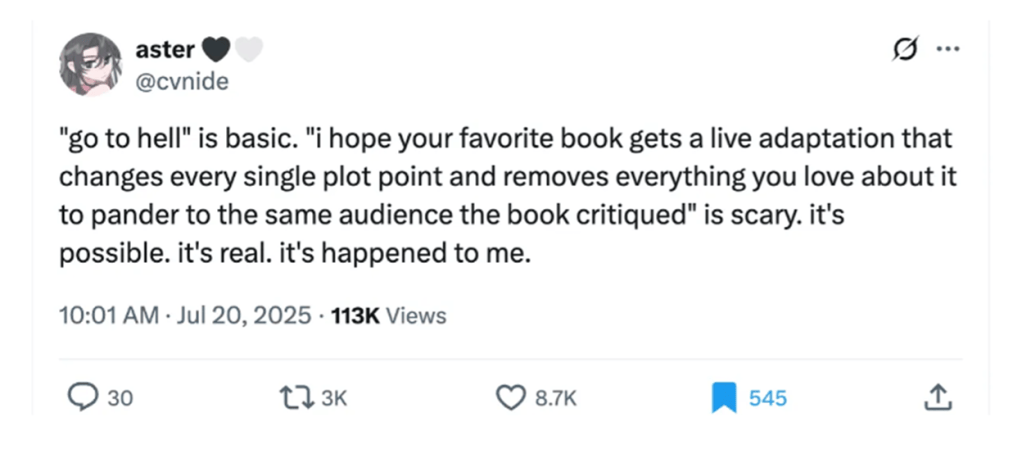
Fans feel a sense of ownership over their favourite stories. This comes with intricate questions. A common one is asking why a specific book is getting a movie, and not a series (“Oh God, how are they going to fit all the details?”). You can see this dynamic play out well in reader frustration toward Netflix’s People We Met on Vacation: many Reddit users argued that a multi-episode series, not a movie, was needed to flesh out more than a decade’s worth of emotional nuances and subplots.
Another question: why didn’t the casting directors cast that actor everybody imagined when reading the book ten years ago (who, of course, aged ten years as well)? Casting anxiety, however, is present in any fandom. Readers often express disbelief when studios fail to cast the fan-favourite actor that the community collectively agreed upon years prior. In the age of BookTok and AI character fanart, it’s even harder for actors to compete with unreal characters, sometimes literally.
When real studio casting announcements drop, fans routinely baulk at studio choices. A prime example of this digital clash occurred with Elle Kennedy’s popular book The Deal (2015) turned hockey romance series, Off-Campus (2026), which follows a college hockey captain and a music major student, Hannah Wells, who strike a deal to help each other — with some fake-dating and tutoring involved! When showrunner Louisa Levy announced Belmont Cameli as the male lead, social media users went into a frenzy. Fans ruthlessly dragged the casting, declaring Belmont “too ugly” to play the hockey golden boy. Fans dissected his lack of tattoos, facial features, and past projects in an attempt to pressure the studio to rethink its choices.
Yet the casting ultimately provided a fascinating counternarrative to fandom cynicism. Once fans saw him in character, they were forced to confront the fact that they were wrong: Belmont brought the character to life with such infectious charm and emotional vulnerability that even people who hated the book loved the adaptation. The very readers who had dragged his looks the previous year were praising him with fan edits as the best actor that could have played Garret Graham. This 180-degree shift highlights a critical truth and hope for the arts. While digital fandoms are fiercely territorial and hyper-critical of initial production choices, genuine acting talent and, most importantly, on-screen chemistry can still trump even the most book-accurate fancast.
Hypothesis 3: One generation’s ‘swoon-worthy possessiveness’ is the next generation’s campus-wide restraining order.
Beyond translating internal monologues, adapting books introduces another challenge: translating tropes acceptable 5-10 years ago for modern audiences. Most of the novels mentioned reflect the social norms, college culture, and relationship dynamics of the years in which they were written. Filmmakers face a delicate production choice that could be a disaster if not handled accordingly: how do you align dated story elements with contemporary cultural standards without disrupting the book’s core?
This tension is especially visible in Off-Campus. Translating the 2010’s college culture was quite a feat. Producers had to re-evaluate dated tropes: toxic fraternity behaviour, casual sexism, and controversial plot devices like Garret’s “campus-wide hands-off law” prohibiting other men from approaching Hannah after their breakup. Modernising these elements for contemporary viewers has sharply divided fanbases: purist readers feel like altering and sanitising the story takes away from the adaptation, while modern viewers argue that adapting older tropes would feel tone-deaf. Fans want to see everything represented from the book, but should that also apply in instances where outdated tropes clash with the book’s message (take, for example, the themes of sexual assault)?
Producers are damned if they do and damned if they don’t. Do you lean on fan service by checking off a list of viral tropes to satisfy die-hard fans? Or do you prioritise coherent narrative structures that would satisfy casual audiences who haven’t read the books? The sure thing is that when studios treat romance as a quick cash grab, online communities have every right to condemn the production. Successful adaptations require a balance of treating the source material as a guide while creating a new product that is welcoming and digestible for new fans.
Hypothesis 4: The probability of an adaptation surviving pre-production drops to absolute zero the moment you introduce pointed ears, six-foot wingspans, and a CGI budget.
Despite this eternal friction, studios continue — and, in my view, will never stop — optioning contemporary romance novels for one simple reason: the controversy may be more in their favour than we think. As we have observed from time to time, fan scepticism rarely stops readers from tuning in. However, commercial optimism hits a steep wall when attempting to adapt high-concept worlds of romance, known as romantasy, given the astronomical production costs which tend to stall such projects.
Just look at Sarah J. Maas’s A Court of Thorns and Roses (2015): a massively popular romantasy book series. Though optioned as a television series in 2021, in 2025 Variety reported that the project was cancelled after years of pre-production delays and script rewrites. Maas reclaimed full screen rights and promised that in the future she wants to oversee the project personally to protect her fantastical world and its fanbase. Her stance follows well-known fantasy author Brandon Sanderson, who has stated similar opinions in the past. This is a broader shift among authors who prefer halting or not even offering to adapt their novels rather than acceding to full studio control and risking the product being diluted into an almost entirely new project.
This new wave of romance screen adaptations has permanently reconfigured the relationship between literature, Hollywood, and digital fan communities, and it’s not going anywhere. Filmmakers need to recognise that, in light of fervent fanbases, satisfying romance reading audiences requires translating the literary interiority and emotional nuances which create the fanbase of these books. As for readers, they need to have faith in casting directors, and that some tropes are better left in the book when modernising the source material.
Maybe in a utopian future, filmmakers and readers would align their expectations and goals. So, could we have those romantasy adaptations in this century, please?
Despoina Karydi (she/her)
A master’s student in the Literature Today programme, and an avid reader of anything romantic! When I am not reading, I am usually watching the latest movies and series, and, right after, internet stalk everything related to them!

