
Breaking the Rule of Three
Seasons of Glass and Iron: Stories
By Femke Kapteijns
Beginnings
Once upon a time, there was a young woman who should have known better than to rely on fairy tales. However, she had been surrounded by them since childhood: cassette tapes, watercolour picture books, and collections of international folk tales. Thus, she learned to never trust strangers, to never take shortcuts, and to wait for her prince on a white horse at the end of the story. Her days repeated and blended together as she endlessly uttered fixed stock phrases. As she would eventually read in a certain collection, fairy tales had become her scripture.
To escape her self-inflicted boredom, she liked to delve into the minds and lives of others. A good friend remembered her reading This Is How You Lose the Time War: how one of its authors had won many literary awards, how the young woman praised its visionary prose, but criticised its unclear plot. Hence, the good friend gave the young woman a copy of Amal El-Mohtar’s latest work, a collection of short stories and poems titled Seasons of Glass & Iron: Stories. The familiar anthological format made the young woman feel a deep-rooted comfort.
Upon finishing the collection, the young woman went to thank her friend for the gift. While walking through a dark forest on the path to her friend’s house, she pondered on her impressions of the collection. Everyone and their evil stepmother, including critics like Capossere, Otto, and Wolfe, had already uncovered its main theme: the love for and between women. This made the young woman think of Virginia Woolf, how she liked the “unconventionality,” “completeness,” and “anonymity” of women. The young woman’s fairy tale informed worldview left her feeling disconnected from these qualities, as well as from the women in the collection who broke each other’s curses, held each other in erotic dreams, and survived clinical trials together.
Straying from this foretrodden path, she reflected more on the collection’s other recurring motifs, the seams mending the stories and poems together. She remembered experiencing Amal El-Mohtar’s sensory writing, the smell of cinnamon and the coarseness of sand. How strange that the words seemed to come alive, less connected to the conventional descriptions of smells and sounds in her fairy tales.
Flowers
Suddenly, the young woman smelled the sweet, alluring smell of flowers somewhere off the path. Although she knew that those who treaded beyond the path were punished, she stopped to gather some. After all, this would make a perfect thank-you gift for her good friend. In the collection she had read that the Latin word for anthology was florilegia: a gathering of flowers.
The young woman had never managed to write something that reflected the images in her mind, only read and hoarded flowers that gave her small comforts. By assembling her own bouquet she could try telling the stories trapped in her throat, the feelings that conflicted with those in her beloved fairy tales, the voice she struggled to find. Just like an anthology, the selection of flowers that transformed into a beautiful woman in the collection, she felt like a plurality trapped in a singular body.
She bundled several flowers together that reminded her of the collection. Some smelled more strongly than others, had thorns that pricked deeper into her fingers, lost fewer of their petals as their little bodies pressed up against each other. She could give those that survived to her friend and tell her about the ones that she lost halfway, if she had not forgotten about them by then, of course. The lilacs, roses, and brooms would sweeten the air of her friend’s room with the memories of women’s lips teaching each other how to turn adversity into advantage. The aconites, bluebells, and sweat peas would wither away in a dusky forgotten corner, their cheap and ornamental smell of purple prose leaving no lasting resonance.
Birds
When she tried to return to the path, it had vanished. Now there was only a trail of various feathers: big and small, soft and prickly, black and multicoloured. In the distance a hooting noise, something between an owl and a goose, echoed. The young woman was not used to being off the path, so she followed the feathers in the hope that they would lead her somewhere. In the trees surrounding her sat various birds: sparrows, crows, cormorants, swallows, hummingbirds, and phoenixes. Their overwhelming decorative aura blinded the young woman; their overlapping tones offered her no help.
When she reached the last feather, she cried out for help. A huge owl turned its head, eyes the size of water wheels. She could not recall this kind of creature from her fairy tales. This beast was much bigger than the birds she usually came across, the ugly ducklings who turned into beautiful swans and the songbirds who helped girls with their quests. It looked, rather, like it had absorbed the words that described the owls in the collection, which the young woman still clutched in her hand. The beast looked like it had devoured the evocative words of hunger, silence, and fierceness.
As it stared right at her, it stretched one of its wings towards her. An offering. Contrasting the other birds, this owl clearly knew how to represent itself. It understood that its underlying emotions and inner character, intense and innovative, were clearly written in its eyes. The young woman found its unsaid words meaningful. It was a creature of the borderlands, one that not only knew how to speak in multiple languages — even silence — but also to find its place in an uncertain world.
Having understood that this bird was free while the others refused to leave their trees, the young woman climbed on its back. She clutched the bundled flowers and bound leaves tight to her chest. As they flew under a star-filled sky, she saw no path on the ground, only the forest endlessly stretching outwards. Eventually, lights appeared in the distance. Not from Glasgow, Damascus, or a steampunk city, but from a little wooden house. The beast suddenly swooped down and let the young woman off its back.
Language
Upon opening the door of the little wooden house, the young woman noticed that the walls of the room were covered floor to ceiling with loose papers. Thousands of languages were written on them, many of which she could not read. After all, she only understood four languages and could speak even fewer. Finally off the predetermined path for the first time in her life, she wished to understand all the words plastered on the walls, wanted to appreciate all the languages used in the collection, wanted to break free from the patterns of the life that she shaped after her beloved fairy tales.
Suddenly, the words began to resonate off the pages on the wall and started to thrum in her head. She recalled how the collection treated the power of words: it bound people together when they were strung into stories, but these words were often too dangerous to exist, forced to be left behind. Although she knew not what it was like to abandon a language, the thrumming replicated that pain for her. She noticed that the words pounding in her head did not manage to create a steady rhythm. The thought of a writer, a poet, an artist, who did not always manage to fully grasp their own use of language made her feel relieved. Finding her own voice did not have to go fluently, all at once.
When the vibration of words ended, the young woman finally knew what to tell her good friend about the collection, which was now spread out on the floor. While its many voices, sometimes overlapping each other as if written on a palimpsest, did not always strike a chord, its tales of finding a common language brought her to tears at other times. The women inhabiting the collection simultaneously knew how to make beautiful music with bells adorning their lips and fail to let their notebooks filled with secret confessions speak for them.
Suddenly, the young woman remembered something. A language was so much more than words to be spoken and understood. It could also be a craft, a gesture, an escape route. Since she had read enough to know how to create art with her own hands, she could practice transferring the words from her heart to paper. She would only be able to change the narrative if she repeated her own words over and over and over again. Thus, she decided then and there that she would learn a new language to carve a place in the world for herself. To let the trapped words in her chest sprout wings.
Having reached the climax of her story, she closed her eyes and waited for her words to finally stream out of her, waited to be miracled away to her friend’s house, waited for the story’s resolution.
Women
You’re surprised to find that you are still here when you open your eyes again. You thought the pattern usually ended after three. Miraculously you are clutching the collection in your hands, flowers crushed against its cover. The walls of myriad words have vanished, leaving you in an expansive gallery. There are portraits upon portraits hanging at different angles, some fixed to the wall with rusty nails and wooden frames, some carefully encased in gold. Without even looking at their descriptions, you realise these are the women of the collection as you imagined them in your head.
Many of the portraits contain multiple women: one kissing the flowers growing out of another’s skin, a young woman teaching a child facts about owls, two women breaking imaginary chains by dispelling the lies they have told themselves. While some have blurred features, others shine brightly. Their personalities, thoughts, and ideals are clearly discernible to onlookers. Despite being mere images, some of the women almost feel like old friends whom you know through and through. Others have faces you do not remember reading about, but would still have liked to know. It feels like there is a barrier between these portraits and you, a gap El-Mohtar filled up with pretty sentences to grab your attention.
Perhaps you, too caught up in the monotonous structure of daily life, should not have been so dismissive of El-Mohtar and her insistence on solely writing about women. While you are finally able to connect to the women in the collection that broke patterns ingrained in you, there is still some glass in the mirror that must be cracked before you can be free of fairy tale tropes. You must leave this fantasy world and revive your connections with the women in your own life. You recall reading somebody named Smith claim that “the rescue narrative is one that repeatedly occurs in fairy stories and other traditional narratives.” By using the words of the women in the gallery as a vehicle for your escape, you will bend this structure and allow someone other than a prince on a white horse to rescue you from the mundanity. You exit the gallery.
Endings
Outside is your friend’s apartment building. You knock. She rushes out.
“Are you okay? You took quite a while to get here.”
“I’m fine. Just took a bit of a detour.”
Smiling, you hand her the bouquet, some flowers crushed against the collection. You mention that they might have needed a bit more breathing space.
You seem to have evaded fairy tale structures for now: no wedding, no punishment, no clear resolution. But there are still many other beliefs to be unlearned.
For example, you still wish that you will live happily ever after.
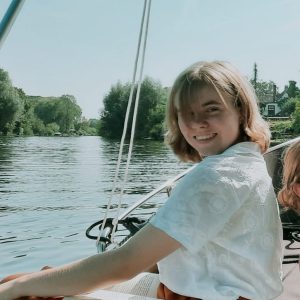
FEMKE KAPTEIJNS (she/they)
I am following the MA Literature Today at Utrecht University. My studies have cultivated my current interest in Critical theory, Queer theory, and Cultural memory studies. Besides reading New Weird fiction and slice of life manga, I enjoy playing board games with friends, karaoke and practicing a variation of martial arts. After graduating, I would love to use my experience from this course and my editing work at the Marxist magazine Paraat! to become an editor at an independent publishing house.

