
Victoria Chang’s Tree of Knowledge and the Patience of Poetry
By Ollie Köhn-Haskins
“The critics think Untitled, 1992 is a tree. I think it is
everything but a tree. […] Joan Mitchell
said, When I talk about love, I mean loving a tree.
When I talk about love, I mean loving where
a tree used to be.”
Some years ago, I spent a few weeks visiting and helping out in an encampment in the woods of eastern Germany. This community was created to protest deforestation — to protect the trees by living with them (and in them) in makeshift treehouses, making it more difficult for them to be cut down without also harming humans. In this case, the trees were being killed by mining companies to access the gravel and sand underneath. This completely disrupts the ecosystem of the bog land, releasing stored carbon dioxide and ripping away the home of many creatures and plants. A short walk from the encampment, there was a massive gravel pit where the trees suddenly stopped and the ground fell away in front of me into a gaping wound.
The forest encampment sustained itself through dumpster-diving, crowdfunding, and storytelling. It was patient. It wasted time listening to the creak of the pine trees in the wind until it was violently evicted by police, after people had lived there for years, because the forest is considered the private property of a corporation that only wants to destroy it for the sake of short-term economic progress, to greedily gather gravel to build faster, bigger highways.
What if we valued slowness, instead? In an interview with Mother Jones, poet Victoria Chang reflects on the brevity of human life: “We are stewards of this Earth. We are guests […] I walked amongst these massive trees that had been here for so long, by myself. […] These trees are really going to be here long after my time, anyone’s time […] it’s our role to respect them and to kneel before them.” Forest encampments disrupt the rhythm of the everyday and try to make space to respect the long lives of trees.
Poetry, too, can be a patient protest against extraction and speed, linearity, and progress. It kneels down and looks up through the canopy of leaves and tries to describe what it feels like to be so small. Victoria Chang’s Tree of Knowledge, longlisted for the 2026 National Book Award for Poetry, is haunted by Chang’s witnessing of a eucalyptus tree in her neighborhood being felled. The poet has been circling tree imagery her whole career, but this is her first time allowing a specific tree to grow roots in her work, which entangle themselves with the many themes that she carefully and self-consciously approaches.
Chang is preoccupied with doing justice to her sensory experience of the world, and, equally, with doing justice to history. Nearly every poem is a response to a specific (usually somehow tree-related) artwork she ties to philosophical quotes, as well as her own life, grief, and familial memories. Throughout the collection, she also shares her artistic research of Chinese diaspora communities in California, in the form of pairs of poems and collaged, embroidered images of various cannery, fishery, and railroad workers.
In putting words to the visual — paintings, sculptures, photos, and her own eyewitnessing — Chang participates in and shapes the long tradition of ekphrastic poetry, just as she has in her previous two collections. From the ancient Greek ekphrasis, “to show in full,” the term stems from φράζω (phrasis: to observe, imagine, guard over, take care of, beware) and ἐκ (ek: used to denote movement through space and time, away from something — descendancy, causation, making something from something else).
Her ekphrasis approaches each visual artwork with wariness and care, moving it through time and space to meet the reader. It is commonplace to say that we are overloaded with the visual in this digital age, and Chang manages to call attention to the neglected aspects of works of art we might have been overexposed to, and to call attention to the forgotten works themselves.
Several poems grapple with the ethical dimensions of representing the world through art, and how art shapes our world. In a poem responding to a 1944 study of a tree by Pablo Picasso, Chang writes: “Things stay alive by eluding our perception. The / same gaze that believes a tree is there for us to draw. // That its branches have tiny offices.” Is it an act of possession, of objectification, to create art of something or someone? An assimilation into the artist’s own specific, narrow view of the world?
In another poem, “Woman in Blue,” again responding to Picasso, she writes: “Once a woman is painted, she is gone.” Marina Picasso, one of Pablo’s granddaughters, writes of his abuse of the women in his life in her memoir: “He submitted them to his animal sexuality, tamed them, bewitched them, ingested them, and crushed them onto his canvas. After he had spent many nights extracting their essence, once they were bled dry, he would dispose of them.” In her poem, Chang links the unnamed woman in Picasso’s painting to the tree, whose branch has been cut off, in his 1944 study. Does this representation of the ‘woman in blue’ repeat Picasso’s violence in making it visible?
Chang turns her critical eye inwards, questioning what it means for her to perform a sort of ekphrastic poetry on her own eye-witnessing of the felling of the eucalyptus tree:
“I never looked at the
tree until the week before its death. I rush to look
at the stump, write about the stump before my
feelings vanish. Charles Wright wrote, The urge
toward form is the urge toward God. But I think that
the urge toward form is the urge away from God.”
Do we distance ourselves from the suffering or pain of others, and exploit it when we try to turn it into art?
The only way for me to make sense of Chang’s own constant self-questioning and her reversals of meanings and sentences is to turn it onto myself, into my world. I try to listen to her when she writes:
“Paul Valéry said, I write
half the poem. The reader writes the other half. I’ve
crossed out the rest of this poem.”
In another poem, Chang draws a connection between witnessing the death of the eucalyptus tree and reading about her own mother’s death from the notes of her caretaker:
“[…] I could watch the men
outside finish their cutting. I sat on the floor, cross-
legged with no one watching me. The country
outside under construction. On the day before my
mother died, Gloria wrote: After repositioning her
and changing her brief, her breathing level dropped
significantly—to 55. At 6:50 a.m., she wrote: Threw
out trash. At 7 a.m., she wrote: End of shift. It’s true,
I’ve written about this before in another poem.”
(Yes, in “Language” and “My Mother’s Lungs” in her 2020 collection Obit.)
It’s true, I’ve written about the forest encampment in eastern Germany before, in an essay for a philosophy class. What makes me return to the same topic, squeezing every bit of academic-social-emotional value out of it, excavating it for words like so many pieces of gravel and grains of sand? How do I communicate the rage, perform, and make sense of grief publicly? One of the protesters was sentenced to over three years in jail, and he is still imprisoned; the gravel pit eats further into the forest and the moor.
Our countries are under construction. Chang’s words were published during the 250th anniversary of a nation built on and maintaining itself through the suffering and death of so many. I read her poems as state elections in eastern Germany make visible a similar violence and disregard, showing a normalisation and support of facism and the far-right.
Throughout Tree of Knowledge, Chang consistently returns to both the felling of the eucalyptus tree and the state-sanctioned racist violence that led to the expulsion of Chinese diaspora communities in Eureka, a city on California’s northern coast. Pairs of the aforementioned archival photos and staccato, free verse poems interrupt and give space between the repetitive, rhythmic flow of her unrhymed but still loosely structured couplets.
These poems, printed in red, are striking, short, and evocative, taking on the perspectives of the photos’ subjects through a re-construction and re-appropriation of words from a newspaper published in Eureka in the late 1800s and the Chinese Exclusion Act of 1882. The strange imagery and wording of these poems, limited by the archival texts, make them the most provocative of the collection. Although Chang’s constant self-questioning of the ethics of artistic representation still reverberates in my ears, she approaches the act of responding to and representing the photos wholeheartedly.
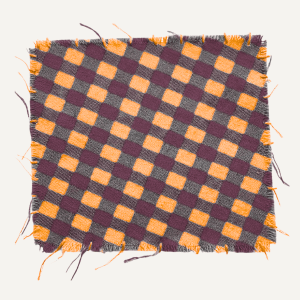
There is something special about the materiality of the archival photos Chang presents us with — their grainy greyscale against the rich colour of her tree photos, collaged together, her embroidery through tiny but clearly visible holes. Her embroidery of the archival photos traces the gazes of their subjects or outlines their clothing and bodies in connection with other bodies and the world around them. Even while first encountering the work through my e-reader, I could feel the worn paper and intricate lines of red thread on my fingertips.
Chang also accomplishes the feat of bringing what may first seem distant to some readers close in “Eureka,” the expansive poem at the heart of the collection, which recounts her visit to the city and its history. This poem gallops across lines and pages with no stanzas, breaking with her typical couplet form, and is centered on each page like the endless trunk of an ancient tree. Much of the poem grapples with the violent policies of the United States and the continual racism Chang experiences in the present. She writes of resistance after an 1885 expulsion:
“The next year 56 Chinese people
filed a lawsuit against Eureka the
lawsuit was dismissed three years later of
course Chinese people couldn’t own land this
land is your land this land is your land this
letter said don’t open the new trees that
maybe land was never meant to be owned”
As she remixes the words of Woody Guthrie’s “This Land is Your Land” to point out the ironies central to the U.S., I wonder how it might be possible to also include, in her writing of history, those who already lived on this land before it was “owned.” Those who were here before the Gold Rush and the westward expansion of white settlers that she evokes, before the nation’s all-too-temporary welcoming of immigrants to assist in its physical creation. I can’t say whether it would have been too complicated, too messy, to include this story, too, on top of the many that Chang already masterfully tells. The Ku’wil community indigenous to the area now called Eureka are absent from the surface of her poetry, but I can’t help but think of their resilience as she continues to question what a country is and what its consequences are — to think of the crossed-out rest of her poem:
“it’s possible language is a country
it’s possible violence stems from language
possible that violence is a signal
it’s possible that these trees aren’t headstones
it’s possible we can outlive violence”
If language can bring violence, can it also repair?
“Af Klint said, Those
granted the gift of seeing more deeply can see
beyond form, and concentrate on the wondrous
aspect hiding behind every form which is
called life. […]
I can go beyond form then: woman,
mother, body, shrapnel. I can see words spread
out, separate from each other, lose all meaning,
become the milky dots they always were.”
Is there a way to dissolve the violence of putting words to images, to feeling? Could that be through poetry?
“Maybe war is our insistence on
the narrative when we are descendants of the lyric.”
What can it offer for us to linger in our short time here as guests on this Earth? To reject a single narrative, a single form, to rework old words and to sit, wasting time, looking at trees?
Ollie Köhn-Haskins (they/them)
I am a research master’s student of Comparative Literary Studies at Utrecht University and work as a student assistant of UU’s Pathways to Sustainability. When I’m not reading and writing (about) poetry, I’m spending time with my cat Ozymandias, tomato plants, and sourdough starter, looking at our neighborhood trees. I hold a Bachelor of Arts in Literature, Philosophy, and Media Studies from University College Utrecht and have been published in the literary journal FRAME, where I now work on the editorial board.

