
The Double Standard: Whoredom vs Qualification
By Daria Nicolae
“(T)hey’ re saying if a woman pays a man to do it, he’s ‘qualified,’ if a man pays a woman to do it, she’s a whore.”
Dear almost modern society,
I always find myself pondering the same straightforward question: How can we be so medically and technologically advanced, yet maintain the same shortsighted views regarding certain matters? A few weeks ago, I, lost within the heart of Amsterdam, overheard an intriguing conversation while strolling through the slippery cobble-stone streets. The topic itself was not particularly perturbing to me. Rather, it was the arguments which were put forward, which served as an uncomfortable reminder of stagnation in terms of society’s prejudices and mentality. I strongly believe that nearly everyone, especially every woman, has, at least once in their lifetime, been present or engaged in a discussion on the sex industry. Usually, this conversation rapidly evolves into a harsh condemnation of the system along with the people involved in it — when writing “the people involved in it,” I specifically refer to the women who pursue a profession within this field. Now, it was my turn to listen and be attentive to the critical remarks.
Adopting a vexed tone, this male acquaintance confessed his disdain to my group of friends, protesting:
“Why do we keep feeding into these females’ delusions?! This way, they perceive themselves as regular employees, a member of the work force — like me — when they are rather below the lowest tier of society!”
This question sent a jolt through all of us. It remained open for the rest of the night. Whether the discussion is built upon a political, religious, or social argument, members of contemporary society keep subjecting the women involved in this line of work to severe criticism, reducing them to degrading language. I stand perplexed by the reasons behind this constant need to target the female sex within this industry.
I recently read The Calamity Club by Kathryn Stockett, set in 1933 in Oxford, Mississippi. This historical fiction novel is the author’s return to writing after 17 years since publishing the award-winning novel — The Help, also set in Mississippi — which received a movie adaptation in 2011. The Calamity Club employs an alternating dual-perspective narrative structure, following two female characters: a 24-year-old small town woman, Birdie Calhoun, and an 11-year-old orphan girl, Margot Lefleur, also known as Meg, whose mother suddenly “disappears.” Through Birdie, Stockett introduces the readers to six other strong-willed female characters who struggle to survive amid economic hardship, racism, and gender discrimination regarding certain professions. Their struggles unravel in the American South during the aftermath of the Great Depression and Prohibition, an era marked by severe shortages in food, housing, and opportunities. Thus, the female characters subvert the restrictive social and gendered norms, creating and illegally operating a house of prostitution.
Kathryn Stockett structures a critique towards the American eugenics movement through the character of Charlie Lefleur, Meg’s mother. While Charlie is an unmarried woman, she is also a single mother struggling to financially support her child by engaging in transactional sexual activities in Mississippi. However, in the 1930s, the South had already embraced a procedure to cleanse society of all people whom the power systems had defined imbeciles. Consequently, anyone who slightly diverged from Southern society’s norms was sentenced to immediate sterilization, specifically: disabled people, epileptics, alcoholics, and all sexually promiscuous women.
As Stockett learns about this law within the process of writing the novel, she decides to build this narrative, exposing the extent to which the South used legislation to assert control over the female body. For example, after being spotted flirting with an African American man in the train station, Charlie is imprisoned for three years, loses custody of Meg, and undergoes the aforementioned cruel procedure. Following the fulfilment of her legal punishment, Charlie employs a plan for earning money and finding her daughter, and, through this plan, ends up meeting Birdie.
Driven by a desperate need for financial support, Birdie Calhoun arrives in Oxford in order to save her family home and ensure her mother and grandmother’s survival. She visits her sister, Frances, who has recently married into a wealthy family. While assisting the newlywed Frances in the poorly maintained orphanage where she volunteers, Birdie’s and Meg’s storylines interweave. Stockett begins to paint a symbolic and heartfelt mother-daughter relationship between the two female protagonists.
In her review in the New York Times, critic Lauren Christensen describes these two alternative protagonists as extremely “sympathetic and utterly hilarious, drawn fully enough that their individual senses of humor feel distinct from the beginning.” I couldn’t agree more. Stockett does an impressive job into weaving light-hearted elements within an otherwise tragic narrative, allowing humor to coexist with the novel’s more serious themes, without diminishing their emotional weight.
I was equally impressed by the narrative itself. Though I share Christensen’s opinion, I’d also argue that Stockett’s writing does not break new ground stylistically. But Stockett proves that she can structure an intriguing storyline through a conventional writing style. Even if I could not describe her storytelling as experimental, I can strongly say that it is carefully developed. Christensen also declares that the novel’s “full-hearted, down-to-earth prose [that] gives the impression of being not crafted at all,” which is true. As her review puts it, Stockett’s plot “delivers” through its richness and well-crafted characters which serve as the perfect complement to this lack of inventive form.
The Calamity Club presents a succession of unexpected turns which maintain the suspense feeling alive until the end. Stockett employs Meg’s adoption as a catalyst within the novel, leading the female protagonists’ plotlines to diverge. Nevertheless, in the awaited denouement, Stockett ultimately reconnects the two narrative voices while she develops Birdie and Charlie’s relationship as a mutually supportive power dynamic.
After Birdie builds up the courage and confesses to Charlie that Meg has been adopted and taken to another state, Charlie is powered by the maternal need and desperation to restore the parental rights over her child. As she needs to achieve financial stability, she begs Birdie to help her gather female employees and open a brothel together under the cover of a dancing studio. Stockett succeeds in displaying the negative attitudes towards this work field by drawing upon them through a first-person narrative voice. While Birdie is a moderately religious, unmarried, country woman, the novel explores her nonlinear process of accepting and recognizing sex work as a proper job, rather than a moral violation. The female character is forced to rise above her conservative principles and becomes Charlie’s primary ally in raising the money needed to save Meg. The two of them cast five women and open the cathouse.
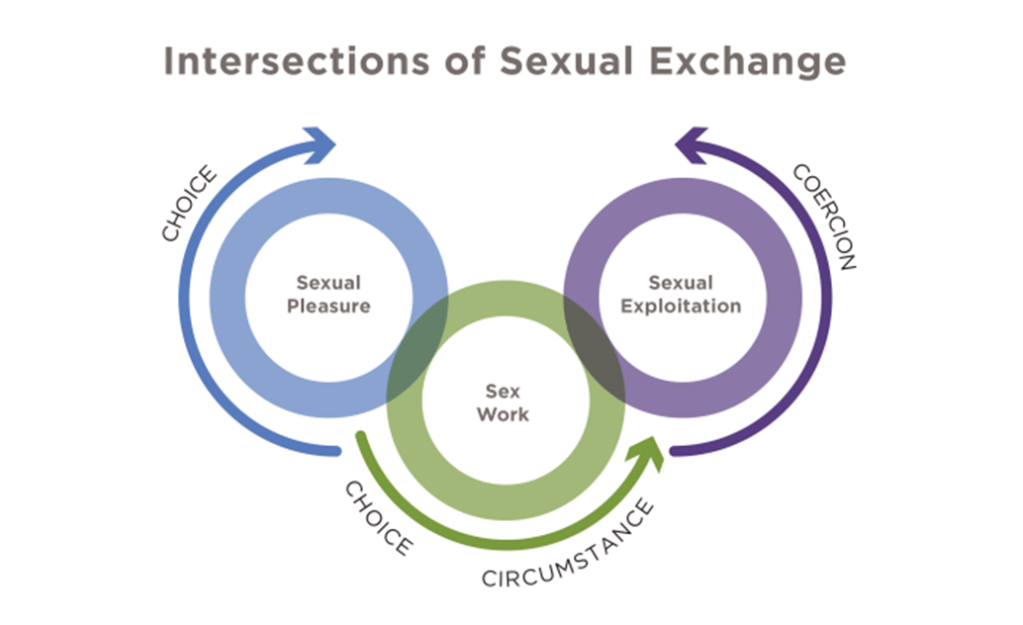
Birdie is initially capable of moral disengagement and willful ignorance towards the dalliances she perceives as immoral. However, the more she is exposed to each woman’s tragic background, the more she emotionally connects with them and her prejudices dissipate. Stockett employs the five female sex workers to showcase the underlying motives and contexts which could lead or force women into this industry, including critical aftermaths of emotional trauma, abuse, and coercion. The novel does not shy away from questioning the difference between choice and circumstance, emphasizing the fragile boundaries which shape women’s experiences within this industry.
In this view, I have included this following diagram as a potential conceptual framework for your contemporary members, challenging the blurred lines between a woman’s agency over her own body, the socio-economic circumstances that might influence this choice, and sexual exploitation.
Finally, Birdie transcends the distant and critical societal lens imposed by the South’s patriarchal systems. She moves past this paradoxical attitude, which simultaneously condemns and objectifies the female body, to fully admiring these women for their resilience and loyal characters. Displaying this shifting perspective, Stockett indirectly addresses you, contemporary society. The novel obliges its readers to also surpass these degrading and conservative views of sex workers as people who lack morals, framing them as strong women and mothers who fight for their survival. But I wonder if Stockett’s narrative holds enough authority to subvert the perspective still embedded in your members nowadays. Can a story crumble the conservative foundation within our world and make us accept this transactional exchange of intimacy as a respectable line of work?
To challenge rigid Southern ideology, Stockett introduces the readers to two contrasting angles over the concept of sexuality. While the novel exposes society’s method of promulgating laws as means of social control over female sexuality, it also prompts the reader to perceive it as the symbol of agency over a woman’s own body and life choices. Beside the sterilization laws, the American Plan also included the legal act of interrogating and arresting all women who dressed provocatively or behaved in a flirtatious manner. Thus, Stockett’s female characters risk losing freedom, both concerning their bodies and lives. However, they persist in utilizing their sexuality within an era of censorship, as they strive for a brighter future.
While attempting to provide an insightful background on women’s oppression, Stockett delves deeper into the South’s legislation. She also brings up the Federal Economy Act from 1932, which mandated that any employee whose spouse also worked for the government had to be dismissed. Despite this law adopting a gender-neutral approach within its phrasing, the novel exposes how male legislators and labor officials enacted it as means to oppress the female sex.
Stockett doesn’t shy away from what this means on the ground. She sketches a discriminatory scene when a hard-working woman sadly confesses to Birdie that the bank dismisses female employees on the view that “the poor unemployed men out there can find jobs, while the wife stays home to clean and cook supper for him.” By explicitly showcasing the South’s job market as severely limited by sexist and economic constraints, the novel showcases what exactly led the six women to sex work.
Assuming that Stockett’s narrative was able to come through and spark some sympathy or reflective thoughts among society’s self-proclaimed modern members, who seem to hold onto conservative beliefs, I am still led to ask: Why? Why do we need a collection of tragic examples in order to dissipate the aversion towards these women employees? Do we necessarily need to emotionally attach to a character in order to show empathy? Is there space for empathy towards fictional characters and none for real people? And if this is the case, can’t we transfer this empathy we feel towards the fictional world within reality?
The author also examines the South’s gendered prejudices embedded within the medical field. Stockett displays a well-crafted critique towards these authoritative institutions and their “right” to exert control over the female body through her character Virginia, who is a medical student. Within the brothel business, she checks and ensures the women’s health. While doing research, she comes across a book which discusses female sexuality as a symptom of hysteria, causing “trouble for others.” Following this diagnosis, the book defines the act of masturbation performed by a male physician as the sole effective treatment. Virginia confesses her rage and frustration regarding this sexist power structure, screaming: “They’ re saying if a woman pays a man to do it, he’s ‘qualified,’ if a man pays a woman to do it, she’s a whore.”
Nowadays, despite the fact that five countries have decriminalized sex work and eighty-six, including the Netherlands, recognise the sex industry as legitimate, women employees still face discriminatory behaviour. In The Calamity Club, Stockett challenges us to ask why many still hurl shame and stigma towards the working women involved in this field. Indirectly, the author stresses an unfolding paradox: Why do you, the 21st century society, which yields outstanding medical and technological outcomes, display resistance to changing your social and gendered prejudices?
Ultimately, I thoroughly enjoyed The Calamity Club not only as a work of historical fiction, but as a thought-provoking novel which inspired me to address you in this letter. I specifically valued how Stockett places male characters in the background of Birdie and Meg’s narratives. While Laura Christensen read them as “universally pathetic, comically impotent in more ways than one,” I found their humorous display intriguing. It prompted me to question the patriarchal structures that still shape you nowadays. Thus, I urge you, society, to reflect upon your rigid standards and understand that women’s choices or experiences should never be reduced to the moral standards set by your members centuries ago. Then, take the necessary steps to implement this change!
Yours almost truly,
a book reviewer & lover

Daria Nicolae (she/her)
I am a Master’s student at Utrecht University in the programme Literature Today. I also received a Bachelor’s degree from Utrecht University after graduating the programme English Language and Culture.
After my studies, I aspire to establish a career within the publishing industry, particularly in editorial work or self-directed writing. In my free time, I am passionate about writing prose and composing poems in both English and Romanian.

