

A critical review by Laid Papinova
Whale, by Cheon Meyong-Kwan, is a novel which, at its heart, tells the story of a girl who once saw a strange, impossibly large fish swimming in the ocean:
In front of her was an unbelievable sight- an enormous fish, several times larger than the house she had grown up in. It crested in the middle of the ocean and spouted a jet of water out of its back… Overwhelmed by the appearance of this unbelievably large creature, Geumbok began to tremble, unable to close her mouth. The fish slapped the surface with its huge tail before vanishing into the water. All of this happened in the blink of an eye. Geumbok stood there for a long time, mouth agape. Was she dreaming? Geumbok asked a fisherman, who had been watching the fish nearby, what that was.
He looked at her oddly. “You must not be from around here. That was a whale…
I start my review with the quote above to articulate the following point, namely, that magical occurrences are an everyday reality for people living in previously isolated, rapidly changing societies. Conversely, to see something you previously thought impossible, to broaden your horizons through a sublime encounter with the outside world, is a state of mind that is increasingly impossible to achieve for us moderns, raised with the internet and often living in multicultural, metropolitan environments. Perhaps this is the reason why one is instantly fascinated by Geumbok, who is awed by a whale much in the same way a reader, in the opening sentence of Gabriel Garcia Marques’ “One Hundred Years of Solitude,” is fascinated by something as simple as ice.
However, the novel also cleverly enforced my already existing belief that this phenomenon, although beautiful, is ultimately tragic. Geumbok’s fascination with this magical new world is quickly shaped by an unfeeling, capitalist mold. Her dreams, too, are colonized. Indeed I recall with some bitterness the passage where she first enters a cinema:
People said incomprehensible things to each other on a big screen. They grew bigger and smaller at will, rode through a desert on horses, shot their guns, and a man and a woman kissed in the back of a wagon. This movie had come from a faraway country, Miguk- or Beautiful Country- America. Geumbok couldn’t tear her eyes away from the screen because of the vivid, shocking scenes and the majestic sounds pouring over her.
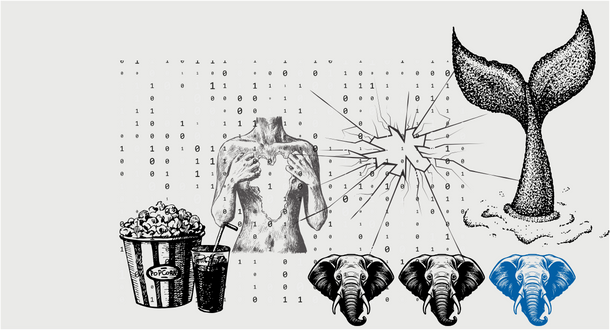
A considerable time after this experience, Geumbok opens a cinema in the shape of the whale which she later saw being slaughtered. Unsurprisingly, this business imitating the shape of a living being proves to be quite lucrative, as Geumbok’s countrymen too are fascinated by American movies:
The movies they saw were usually from a country called America, and they found the movie stars and their lives depicted onscreen to be so impressive that not only did they start mimicking their behavior, some even moved to America. A single proposition took root in people’s minds… The proposition that determined every aspect of people’s lives was this: Everything that is American is beautiful.
Again, I emphasize my bitterness, because my home country of Albania was also once obsessed with these awe-inspiring movies from beyond the sea. Instead of westerns, the sword and sandal genre, probably due to its underlying collectivist message, was allowed by the communist regime of Enver Hoxha at that time. I recall my father telling me stories of how the cinemas of Tirana once bustled with people trying to watch for the third or fourth time in a row movies such as Spartacus or Hercules. Actors such as Steve Reeves and Kirk Douglass were idolized much in the same way John Wayne and Clint Eastwood are idolized by the Korean people in the novel. Clearly both Albanians and Koreans were fascinated not by the movies themselves, but by the western utopia which these movies represented. Indeed, my father often described in vivid detail the hopes, dreams and ambitions of the Albanian people during the fall of the Eastern Block: Everyone was a future billionaire. Everyone was the protagonist of their own movie. Everyone thought happiness lay just beyond the sea or that this sea of freedom and abundance would finally come to them.
In just a few years, however, these hopes and aspirations quickly gave way to the brutal reality of unregulated capitalism. After the communist regime finally collapsed in the year 1990, many Albanians, unfamiliar with the new economic system, quickly invested in state-sponsored pyramid schemes. A portion of the population lost everything they had, and the anti-government protests which ensued culminated in the anarchy and violence of 1997. Therefore I, who was born and raised in a modern, safe, stable, and increasingly dynamic Albania, can only regard with disbelief and fascination the daring, reckless ambitions which my father described to me, and which are exemplified in the novel by characters such as Geumbok. This was the same state of mind which brought suffering to two countries so far apart both geographically and culturally.
At this point, I must step back from parallelisms with my own country and focus on the ways in which Whale analyses the historical particularities of South Korea. More precisely, the novel shows a South Korea still affected by broken dreams. Geumbok’s life, for example, is plagued by a grief exemplified in the slaughtering of the whale. The juxtaposition between a beautiful ideal and an ugly reality, or between a hope inexorably linked to life and the inevitability of death, pushes her to a state of denial, compulsively pursuing grand entrepreneurial projects. It is telling how Geumbok responds to the death of another majestic animal, namely Jumbo the elephant. Jumbo’s body is taxidermized, partly to help the twins who took care of him cope with his passing, but most importantly, so that Jumbo can continue to fulfill his role in advertising Geumbok’s caffe. Thus, one of the novel’s most important messages is made clear: Unrestrained capitalism creates cold, dead copies out of broken dreams.
Under this revelation, the novel’s portrait of Geumbok as a powerful businesswoman with considerable political influence, is also telling. This character is undoubtedly meant to represent a part of those people who served as the architects of the modern South Korean nation. This is despite her being politically uneducated, not even knowing what communism is: “Geumbok yawned, bored… tell me what this communism is about’’. Therefore, Myeong-Kwan’s satirical wit is at its peak in the following passage: “…Geumbok became a firm believer in the need to eradicate communists and took on the role of Chair of the Women’s Subcommittee of the Pyeongdae Anti-Communist Alliance, which was just one of dozens of roles she was asked to serve by various political, economic, environmental, religious, academic, sports, and local organizations…”.
And who is this powerful architect of the future? A woman whose grief has alienated her from her only child, Chunhui. Clearly Chunhui is destined to work as a brickmaker in her mother’s factory, not only because of the former’s obvious talent, but also because Geumbok is too careless to think about another future for her daughter. This relationship between the two characters, or lack thereof, serves as a critique of modern South Korea. Indeed, the novel implies that behind this country’s unprecedented economic success, lies a society which prioritizes productivity over happiness and personal expression, and whose primary aim is to create workers for increasingly powerful corporations, referred to as chaebols by the Korean people. Myeong-Kwan even makes an explicit, albeit humorous reference to this problem: “‘Overthrow the chaebol dictatorship and form a workers’ paradise’”. Thus, it is not a coincidence that Chunhui, as a representative of the younger generation, is mute, or that it was her destiny to burn to the ground the façade created by her mother.
Whale is not, however, simply a critique of capitalism and modern South Korea. Despite the problems which inevitably come with modernity, the novel also shows how this new world provides more freedom and better opportunities for people previously oppressed by patriarchal norms. For instance, Geumbok’s entrepreneurial spirit challenges the traditional conceptions of a woman’s role in society: “Nevertheless, people were impressed by her unwomanly capacity to boldly pursue new opportunities (Myeong-Kwan, 169). Moreover, unrestrained by the traditional duties imposed upon her sex, Geumbok freely expresses her gender identity, as she, or rather, he, choses to spend the remainder of his life as a man. The novel also shows how the adherence to a strictly patriarchal and supremacist conception of masculinity brings only suffering not only to women, but also men. Indeed Geokjeong (Geumbok’s husband), no longer able to fulfill his masculine duty as a provider, transforms from a kindhearted person into a jealous abuser. Another example comes from the man with the scar, who destroyed his life and mutilated himself to prove his manhood to a woman.
Lastly, I must mention the novel’s style. Although Whale employs numerous magical realist elements (Chunhui’s ability to communicate with Jumbo and the one-eyed lady’s ability to communicate with bees being the most obvious examples) it owes more to Charles Dickens than to the Latin American Boom. The eccentric characters, the numerous, interconnected plots, and the focus on those at the bottom of the socio-economic ladder, are all signs of this Dickensian influence. Myeong-Kwan has not, however, created a simple pastiche. The grotesque sense of humor prevalent in Whale goes to lengths unthinkable for a Victorian novel. Naked bodies, as well as sexual acts, are described in excruciating detail, perhaps to the discomfort of some readers. The novel also does not shy away from depicting the most vile aspects of human behavior, such as rape and murder. Nevertheless, a signature warmth prevails on almost every page. Despite their faults, I could not help but feel a certain degree of sympathy for each character and their struggles. For as long as they are alive, hope is certainly not dead.
In conclusion, Whale depicts the paradoxes facing a society learning to adapt to unprecedented change. I was especially moved by the novel’s exploration of the trauma which this change ultimately entails. This trauma affects not only the generation that directly experienced it, but also the generation that comes after it. Indeed I feel very grateful for the life I have, knowing that my own parents were raised in a dictatorship not too dissimilar to the North Korea of today. Therefore I applaud this novel for exposing a crime often overlooked: Isolation.


ABOUT THE AUTHOR
Laid Papinova is an ‘English Language and Culture’ graduate from Utrecht University. He is from Tirana, Albania. His specialisation is in intertextuality, and he holds a minor in ‘Literature in Conflict’.

