

A review by Fenna Leeuwenburgh
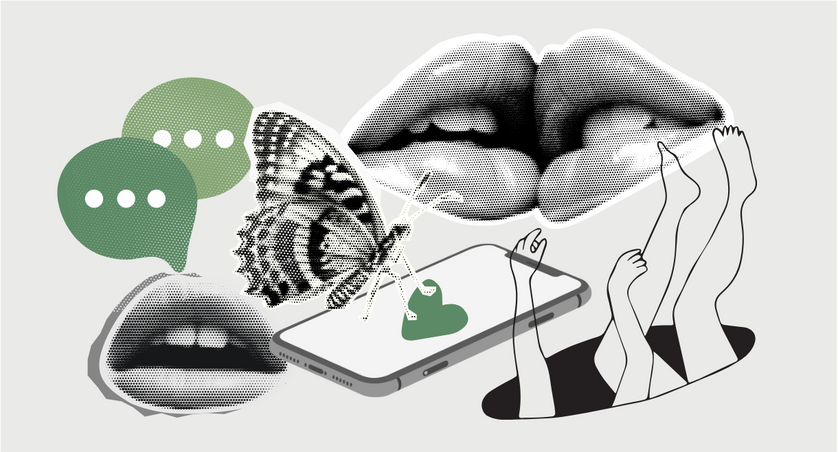
“I am not in love! Hooray!” “Sudden fall long stop”, one of the first poems in Savannah Brown’s latest poetry collection, conveys a seemingly cheerful, slightly unsettling message that recurs throughout the rest of the book: to love and be loved is to be vulnerable, and to be vulnerable is both terrific and terrifying. Closer Baby Closer incorporates references to the internet, London, space, insects, dreams, birds, and nightmares to describe several stages of a relationship; the book casts an original light on intimacy in the modern age through “a lens that burns as often as it illuminates”, as is stated on its back cover.
The collection is divided into three parts, each with a slightly different tone and message, that come together nicely as a cohesive whole. Closer Baby Closer is similar to some of Brown’s previous work, which includes two novels, The Truth About Keeping Secrets (2019) and The Things We Don’t See (2021), and two poetry collections, Graffiti and Other Poems (2016) and Sweetdark (2020). Thematically, Closer Baby Closer is the most similar to Sweetdark, which is described as “at once philosophical and accessible”, with “London (and occasionally the apocalypse) as a backdrop, Sweetdark explores… the pursuit of vulnerability, pleasure, chaos, and the dichotomy of a life wholly experienced, full of so much darkness and so much sweetness, sometimes in the same breath.” Several of these themes recur in Closer Baby Closer, especially the exploration of vulnerability.
The first section of Closer Baby Closer, as Brown herself mentioned in an interview in Our Culture Magazine, describes “the joys – if you could call them that – of intimacy… it’s not a particularly joyful collection of poems, but in my head I’m like, there’s joy in the terror.” In poems such as “Sudden fall long stop”, “Unmute me unmute me unmute me!” and “Olber’s Paradox”, Brown describes both the feelings of exhilaration and apprehension that can arise at the start of any new relationship, and she invites the reader to feel them with her.
For instance, in “Sudden fall long stop”, she describes in great detail the physical act of falling, and uses it as a metaphor for falling in love with someone new. Through the use of this metaphor, she vividly portrays the fears of intimacy and of the future that someone can experience in this situation:
the weightless sensation of falling
you get from the float
of your organs
or at least their strange upward tug,
including the heart,
yes maybe yes especially the heart
In the last line of this passage, the repetition of “yes maybe yes” directly exemplifies this sense of uncertainty that the speaker and the person that they are addressing are feeling, both towards each other and within themselves. The writing also contains a sense of determination, which is in direct conflict with the insecurity, but remains palpable within the sentence; logically speaking, the two emotions should not be able to exist at the same time, but nonetheless, Brown captures the essence of both within a six-word sentence. At the end of the poem, she concludes,
oh no,
it’s true. Once you’re up there, I mean.
The only way back is down
evoking a sense of surrender to the sensation of falling, despite the looming fear that is present in the poem. Trepidation and excitement continuously exist as one intertwined emotion in many of the first section’s poems, which sets the tone for the rest of the collection.
At first glance, the second section of Closer Baby Closer may seem shorter than the other two because it only consists of three poems, but this is deceptive. This part contains the most experimental and some of the most interesting work in the entire collection. In it, the narrator’s perspective on love and relationships drastically changes, as Brown herself has noted: “The middle section is like: ‘This is the worst that’s ever happened to anyone. This curse of existence that I have to give any part of myself away to anyone, ever, is absolutely dreadful.’”
A particularly intriguing poem in the second section is called “Nightmare stations”, which Brown based on a speculative horror novel that she wrote herself and that served as the catalyst for this poetry collection: “It was about a couple who undergoes experimental relationship therapy that’s meant to make them feel like they’re in the same body… I sort of ended up breaking it down and repurposing it for a lot of the middle section of Closer Baby Closer.” This poem, which is the longest in the entire collection, is written in a different typeface and format than any of the other poems; it mimics a sort of ‘code-language’, which gives the reader the ominous sense that Brown’s voice has been pushed to the background and that a new, erratic, and mechanical narrator has taken its place.
This section distinguishes itself from the other two, not just because of its sudden thematic pivot away from intimacy and towards horror, but also by not feeling distinctly and exclusively human in its narration, without losing any of the honesty that Brown so skillfully incorporates in her work. For example, in the following passage, she brilliantly mixes the robotic tone that makes the poem unique with the more vulnerable lyrical voice that has become so familiar to the reader in the earlier poems of the collection:
> oh my shared humanity # I knew from
> the second it hit
> water # that the flayed red astronaut
> the size of a fist
> was ours >>>>
> I’ll admit that I’m horrified # of my own
> biology
** Its limits Its failures
> What it craves # A chain link # organ
> Little vessel circled like a ship
> made of flesh # going nowhere >>>>>>
In this passage, the speaker addresses their state of being, the fears that they have concerning themselves, the other person whom they call “my shared humanity”, and their own body. The feelings and worries that the poem addresses are distinctly, unmistakably human, but the format and font that the poem is set in make the reader question whether the narrator is even human to begin with.
The third and final section of the collection, as Brown explains, is “a lot lighter… It was the joys of intimacy, the terrors of intimacy, and then the last part was like, ‘I’m just gonna go out on the town.’” After the emotional and experimental crescendo in Closer Baby Closer that “Nightmare stations” provides, the third section returns to its original narrative style and format, beautifully wrapping up the collection. Brown continuously reflects on her own identity, girlhood and the social expectations and assumptions put on girls and women, such as in “My god, girlhood ripened”, “Call and response”, “Shared consciousness of the party girl” and in “THE HOTTEST GIRL IN THE WORLD!!!!!”.
In the latter, Brown blends witty imagery and a sardonic sense of humour to undermine the image of the ‘perfect’ woman from a patriarchal standpoint, or in Brown’s description, “Our glittery idiot savior / The exquisite god we despise” (59). In the poem, she describes this stereotypical image of a woman in detail:
She is wearing low-cut
paradoxes and thinks about her boyfriend
for a minimum
of nine hours a day […]
She is vividly sexy and precious and dying
like the coral reef as photographed for Playboy
She is moving to a city near you
She is online now and ready to chat
We know
Where she lives
Additionally, in this section of the collection, Brown comments on the consequences of wealth inequality and capitalism, such as in “Jeff Bezos’ sexts”, a gripping, satirical poem which she wrote exclusively using words from texts Jeff Bezos sent to his now-fiancé, Lauren Sanchez, and in “Every time we go for a walk we’re like wow look at that house”, where she writes that “Around us the times are inflating” and that “[m]y friends rent the rooms of people who hate them. I want my piece. I want something unlosable. I know you’re worried. My friends are making money for people who hate them.” The final section of the book covers a range of different topics, bringing the collection to a close both in terms of content and tone.
Overall, Brown’s Closer Baby Closer is an enchanting collection of poems that, while it addresses themes that are fairly common in her earlier work, is innovative in its approach and execution. Brown employs a writing style that is highly self-aware, occasionally verging on self-deprecation; her poems are vulnerable and honest, and they flow very naturally, even in the more experimental “Nightmare stations”. The poetry collection takes you along through the potential joys and terrors of intimacy – “lover’s noise” may be an “awful sound”, but throughout Closer Baby Closer, it echoes through the pages and haunts you, making sure you won’t forget how terrifying and beautiful love can be.

ABOUT THE AUTHOR
Fenna Leeuwenburgh, a 23-year-old graduate student in the MA program ‘Literature Today’ at Utrecht University, has a passion for English literature that they bring to their current role as a teaching assistant. Their interests extend to several literary genres, including fantasy, poetry, queer literature, and science fiction. Prior to their current academic pursuits, Fenna served as the Head of Photography for Phoenix Magazine for two years, which allowed them to cultivate their artistic eye and attention to detail.

