

A critical review by Mara facon
When I was around eight years old, my parents started sending me to therapy. I was bewildered by the fact that they would even consider it necessary, because I didn’t think I was ‘crazy’. Nonetheless I obediently went to a child psychologist for a few sessions, and we talked about why my swimming lessons made me feel like crying.
I didn’t really see the point of this exercise, so I only returned to therapy in my adult life. By this point, a lot of my peers were not only discussing therapy but also considering it for themselves. Coming of age meant we had to grapple with changes to both our bodies and minds, under constant threat of buckling beneath the weight of problems outside of our control. Living through the Covid-19 pandemic shifted our perception of mental health issues once more, because in isolation, so many more of us were affected by them. I remember whispering to my therapist over Zoom, fearing that my family could overhear our conversations when they passed my room.
When the restrictions were lifted, it felt as though our collective awareness had altered. The stigma seemed to have decreased. At the same time the normalization of discussions of mental health also led to the topic being glamourized in recent times. On the internet, an image of a mentally unwell girl à la Angelina Jolie in Girl, Interrupted has begun circulating and gaining popularity. These girls smoke copious amounts of cigarettes, read Russian novels, listen to Lana del Rey. Put simply, they embody a new kind of cool.
Picking up Jen Beagin’s Big Swiss, my preconception about the novel was that it would fit into this category of media about sad, unhinged women. The appeal of this was definitely not lost on me. There’s something attractive and refreshing about difficult, complex feminine characters who simply don’t give a shit. Growing into womanhood can put a lot of weirdness into your head. You’re often told to suppress your emotion in favour of being deemed socially acceptable. As artist Audrey Wollen expresses in her Sad Girl Theory, women can “consciously disrupt … the status quo through enacting their own sorrow”.
My worry, however, has been that the rise of the Sad Girl places women into categories that fetishize and dumb down their experiences of pain and trauma. Branding certain behaviours or interests as part of being an unhappy woman is ultimately reductive – not to mention how it all comes back to feeding into consumerism – but it’s remarkably pervasive. In my head, a vision of Big Swiss’s main character as an Ottessa Moshfegh reject had developed before I even got beyond the first few pages. And I was right, to some extent, but also very, very wrong.
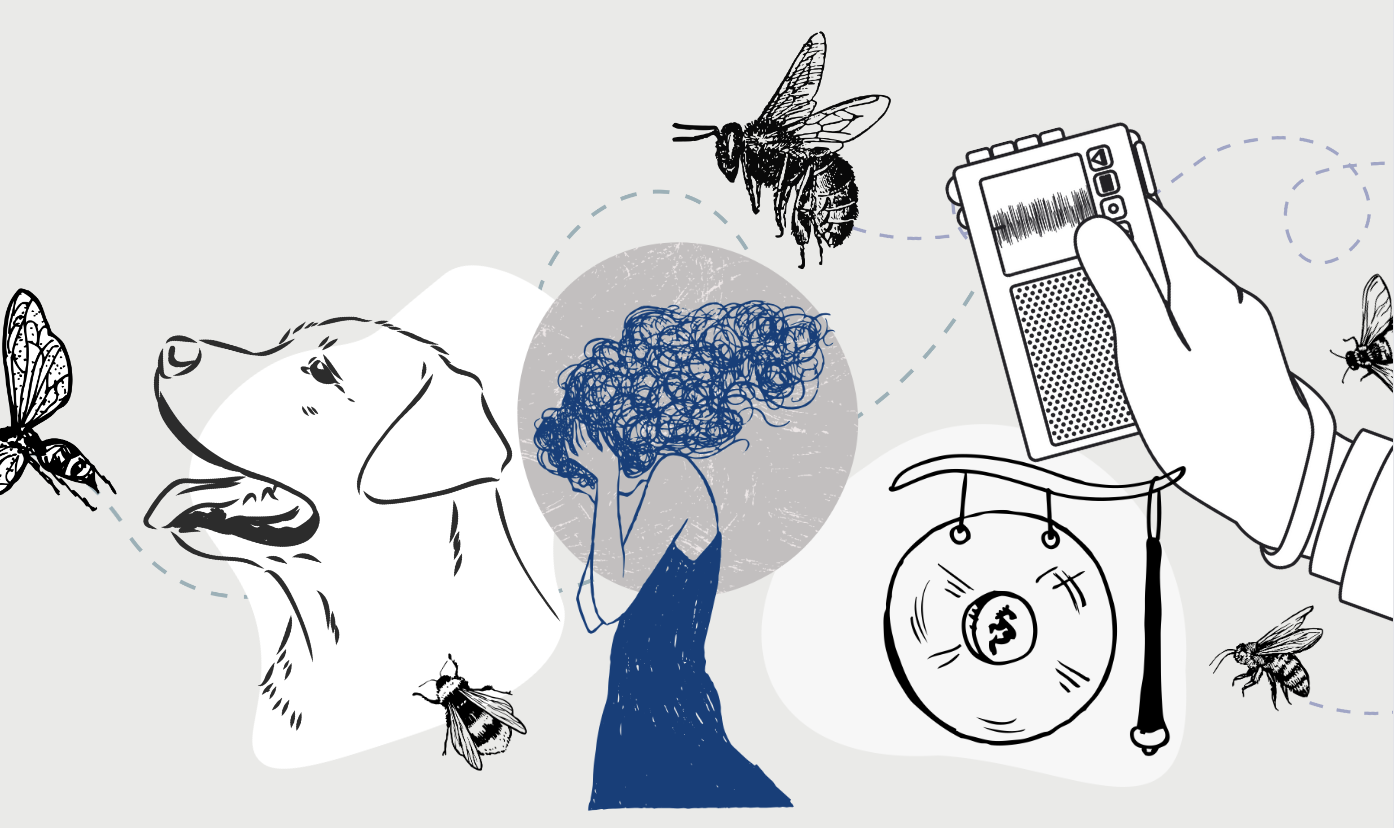
Greta lives in a crumbling 300-year-old Dutch house outside of Hudson, NY with her friend Sabine and a sprawling hoard of animals, ranging from Greta’s idiosyncratic terrier Piñon to a hive of bees that inhabit their kitchen. Just like her home, Greta has been slowly heading toward physical and psychological disintegration for many years. Her mother committed suicide when she was a child, leaving her aimless and emotionally stunted. At 45 years old, she has never had a stable job in her life and finds it hard to take care of herself adequately. In her current employment, as a transcriptionist for the local sex-therapist Om, she encounters her unsuspecting small-town neighbours at their weakest, their most indulgent and self-pitying. But one of Om’s patients, an enigmatic woman from Switzerland, catches Greta’s attention.
Big Swiss, as she nicknames her, has experienced a violent assault, having been almost beaten to death by a man who is soon to be released from prison. In spite of this traumatic experience, she doesn’t wallow during her sessions; in fact, she displays a detachment that is quite similar to Greta’s. The two eventually run into each other at a dog park, where Greta makes the spur of the moment decisions to a) lie to Big Swiss, whose real name is Flavia, about her identity, and b) meet her for drinks the next day.
Drinks turn into daily walks with their dogs, then into a full-blown affair, all the while Greta still listens to and transcribes Flavia’s therapy sessions. Her game, which hasn’t been played masterfully in the first place, eventually unravels completely. Flavia finds out that she’s been lied to, their affair is revealed to her husband and finally, Greta is let go from her job under the condition that she visits Om as a patient and transcribes her own sessions. At the novel’s end we find Greta in a more hopeful place, healing her broken heart with the help of two mini donkeys that live in the stable outside her home.
Big Swiss’s protagonist is eccentric, which is reflected in how she tells the story with all of its dry humour and minute details. Beagin also plays with form, allowing Greta’s voice to interrupt the transcripts to comment on what’s happening or having her thoughts suddenly take the shape of the transcriptions without her being able to control it. But Greta’s grip on the narrative, however dubious it was from the beginning, slips at a certain point. During their affair, she can no longer hold on to her role as an auditory peeping tom, instead regularly spilling her guts to Flavia. Greta sees Flavia as aspirational, first and foremost. She wishes that she could mirror herself in her lover, particularly when it comes to how she deals with her trauma.
Greta appears to know what her problem is from the start: her mother killed herself, she cannot feel emotions properly, and she is suicidal. But this knowledge doesn’t actually enable her to act; in fact, she is clearly stuck in her traumatic past, writing urgent notes to her dead mother, and letting life pass by her. Her suffering is distinctly unappealing, far from the coolness of the stylish Sad Girl. This is reflected in her living situation: not only does it rain directly into her room, but Greta and Sabine’s home is regularly infested with insects, which are treated not as pests but as roommates. At one point a colony of ants “passes through” her bedroom to which she reacts by simply moving all her belongings into a small chamber until they are gone again.
Greta is completely helpless in these situations, returning to a child-like state unless someone is there to pull her out. Meanwhile, animals like the dogs and donkeys take on the role of typical therapy animals – a comparison Greta would probably scoff at – because they involve her in a process of mutual care and comfort. But deep down it seems as though Greta wishes she could see things like Flavia does: to accept trauma as part of her life and stop “rolling around in [her] own shit”.
This approach to trauma seemed cynical to me when I read the novel. I felt called out by the characters’ refusal to give in to common approaches to therapy. In fact, I wouldn’t simply call it resistance to therapy but to emotion generally. Until the very end, I felt like Big Swiss was meant to turn you off of feeling forever, because you’re just throwing yourself a pity party that doesn’t end up helping you in any substantial way anyways. It struck me as old-fashioned, more Baby Boomer than Gen-X in its ‘suck-it-up’ attitude. The description of Flavia’s assault made me (a Gen-Z-er) feel for her quite profoundly, which is something that I wished the novel had done as well.
One of Big Swiss’s last chapters offered me some much-needed untangling of Greta’s past through her therapy session with Om. I finally got a sense of the truth underlying her attitude, as she uncovers the extent to which she was involved in her mother’s passing. Their relationship was defined by her mother’s bipolar disorder, which led to a lot of pressure on Greta from an early age to suppress her emotion and keep her mother from spiralling. But when her mother “threatened suicide for the nine thousandth time”, Greta gave her blessing to go through with it.
Om sees Greta recreating the conditions of her childhood in her relationship with Flavia, essentially morphing into her own mother by desperately hanging onto someone she loves, making her survival depend on the presence of one person in her life. Considering Flavia’s attitude towards trauma, Greta might have known she would enable her inaction about her mental state. If things had been left to run their course, Greta might have even come to rely on Flavia to give her a reason to end her life.
By separating the torrid couple at the very end, Beagin offers Greta the chance to change for the better, even though it means risking a lot. Greta has to admit to herself that her trauma isn’t somehow too complicated or unique to examine. It could lead her in the right direction. Maybe she can break the cycle created by her upbringing. Maybe she’ll escape the Sad Girl fate by allowing herself to be both complex and understood by someone. Maybe we can all stop playing it cool, put our pain on the table and ponder over it like a jigsaw puzzle.

ABOUT THE AUTHOR
Mara Facon is a Swiss post-graduate student, living and working in the Netherlands. Their main interest is in queer literature and contemporary poetry. In their thesis for their studies in English and History at the University of Basel, they analysed the poet Sumita Chakraborty’s use of animal symbolism and metaphors. They were also active as an art educator at the Kunstmuseum Basel.

