
A critical review by VIOLA BECAGLI
When I started rereading The Rachel Incident, I decided I would underline every quote that I found relatable to myself and my life. When I finished the book, it was hard to find a page where I didn’t underline at least a couple sentences. I was Rachel and Rachel was me.
My first copy of the book was a Kindle version. I was attracted to it because, in Vogue’s column The Best – and Most Anticipated – Book of 2023 (So Far), it was compared to Sally Rooney’s Conversations with Friends. So I thought “This is my book” following my recent obsession with the novels by the young Irish author. I say obsession not because I deeply liked the books, I didn’t even finish reading Normal People, but because I feel that her stories have something to do with me, it feels personal despite my irritation towards the characters of the narration. So what I was expecting from this book was for it to help me understand what makes books like Rooney’s feel so personal.
But during my first reading, my hopes of liking this book started to fade. The novel didn’t bring me the emotions that I was expecting to feel; the characters were grey like the screen of my Kindle, and I was getting bored and sleepy. I was disappointed.
I decided to do my second reading with the paper version. When I went to the bookstore, I saw the cover for the first time. It was full of colors, depicting a faceless young woman looking away from me. It radiated possibility, hope, fun. The person who said “don’t judge a book by its cover” was clearly someone who had seen very boring covers.
The second reading revealed itself to be totally different, maybe because the book was physically there in my hands or because I knew what the other reviewers’ opinion was, but I laughed, I cringed, the characters were alive. I understood that what made this type of novel feel so personal was the life they were depicting and not any type of life but what we, I mean people in their twenties, are living through.
I felt very lucky because it doesn’t always happen that you read the right book at the right time, which is the opposite experience of what happened with Sally Rooney’s books, or maybe it’s just not my taste. That’s when I started to think on how much I wanted to write this review in a way that makes people realize the importance of reading this book, especially in your twenties.
The author of the book, Caroline O’Donoghue, is a young Irish writer, and she is the host of a podcast called Emotional Garbage where she revaluates the importance that chick-lit books have for a young audience.
The story, narrated in retrospect by a now-34-year-old Rachel, brings us to Cork in the early 2010s where a 20-year-old Rachel is trying to survive between a not-very-exciting college life and a part-time job at a highly frequented bookstore. In this setting she meets James, a closeted-gay man with whom Rachel immediately starts a deep friendship. Their relationship will eventually become complicated with several dramatic events, ranging from James’s secret relationship with Dr. Byrne, Rachel’s college professor, to Rachel’s accidental pregnancy and subsequent abortion attempt. All of this narrated by a married, happy, and pregnant Rachel.
The whole narration is in first person, but it jumps from centering on one Rachel to the other, expressing the emotions and impressions of young Rachel in contrast with the more objective and mature eye of the present one.
Despite the overall appreciation of the book on Goodreads and in the literary section of the New York Times and the Irish Times, the general opinion about the protagonist was that she is inevitably an unlikable character. Maybe they read the wrong book at the wrong time. Rachel is too instinctive, too emotional, too self-conscious and she makes too many bad decisions – so much so that you just wish, as a Goodreads commentor writes “she’d LEARN a couple of life lessons and just grow up”.
But I believe that this is exactly this book’s and Rachel’s appeal. As Claire Messud argued in a Publisher’s Weekly interview, stating that “If you’re reading to find friends, you’re in deep trouble. We read to find life, in all its possibilities. The relevant question is not ‘Is this a potential friend for me?’ but ‘Is this character alive?”’.
To me Rachel is alive. She makes mistakes and bad life choices and sometimes she is forced to face sudden adult problems that she tries to solve at the best of her abilities. And she is also surrounded by characters that, like her, try to survive and enjoy themselves in the life that they have. In the episode of Emotional Garbage dedicated to The Rachel Incident, Caroline O’Donoghue talks about Carey, Rachel’s ‘boyfriend’. At first and second sight he is considered a hopeless ‘fuckboy’. He disappears for days and does not answer her texts. But in the end, he turns out to be human. He takes care of his dying mother and rebuilds himself, becoming a better person in the process. This novel is not only a coming-of-age story for Rachel but also for all the characters in the book.
I must admit that Rachel’s insecurities and overthinking are actually my favorite thing about the book. O’Donoghue gives voice to all the little thoughts in your mind that make you feel self-conscious and uncomfortable and turns them into something ordinary and relatable. It gives a shout-out to all the girls that had a height complex growing up, being taller than most boys and envious of the petite girls that didn’t make boys say things like: “Wouldn’t want Rachel on the wrong side of me in a fight!”
Present-day Rachel makes you understand that all of this is okay, that it is fine to be a tall girl and not be able to impersonate the “Bookshop Girl”, “caught in a beam of sunlight looking elegant and melancholy, possibly writing a poem at the same time,” an impossibility for Rachel because “it’s strictly for short women.” She tells us that it is normal to have bad sex while, still, you “couldn’t have been more obsessed with having it.” And it’s also normal to have the most random and embarrassing thoughts like “Are we gonna fuck?” or “I hope he doesn’t want to have sex; I’m still on my period.” when you are somehow alone with any type of man. And that doesn’t mean that you’re dirty or a pervert, it just means that you’re human, maybe horny, but in the end who isn’t.
Rachel’s overthinking and need for validation, especially male validation influences all her relationships within the story. All of these are, to my surprise, only relationships with men except for Deenie Harrington, who is the only other woman to have some kind of plot relevance. The answer to why Rachel doesn’t have any other interaction with women is because she finds it difficult to identify herself as a woman except for her capacity to have sex with men. She feels inferior to women, so she relies on her body and eroticism in order to have some kind of validation of her femininity.
Rachel counts heavily on the opinion that men have of her and sees them as some kind of guide through her chaotic life. She is convinced that men are simply better than her at living life. Starting with James, her closeted best friend, whom she describes to us as “extremely advanced. A person who had interrogated all sides of his soul. He was too emotionally intelligent to get stuck into the doldrums of what music or behavior seemed gay or straight. … He was the future of people.” Young Rachel accepts his justification of not being out of the closet as something prizeworthy, but the present-day Rachel interjects, “He was actually terrified,” giving an example of the older protagonist rational voice.
In regard to the relationship with Dr. Byrne, I would classify it as a more father-daughter relationship. Although Rachel has erotic feelings for him in the beginning, her approach changes after he starts a relationship with James. But she still very much values his academic opinion on aspects of her life. The first time that he comes to her and James’ house she thinks “What was even more embarrassing was the thought of him looking at my bookshelves. … What conclusions was he drawing about me down there?” Her self-consciousness comes to the surface, she wants to know what he thinks about her books, therefore, about her, even though he came to the house to have sex with James, so probably the books probably were the last thing on his mind.
Dr. Byrne’s character is the one that I found closest to Sally Rooney’s depiction of men, similar to Nick Conway in Conversations with Friends. Dr. Byrne also has a relationship outside of his marriage. Although I found both of them as equally pathetic in their obvious insecurities, I can empathize with Dr. Byrne a bit more, because he is a closeted bisexual. He is hiding. While Nick Conway’s betrayal comes from an unhappy marriage and probably the temptation of a younger woman, Dr. Byrne’s situation is different. He is in an unhappy marriage, worsened by the impossibility of having a child, but he is also imprisoned by the social rules of his community and his country that limit him in his expression of love.
This is, I believe, is O’Donoghue purpose. She wants to make us empathize with the characters, especially the male ones. She talks about this in her podcast and confirms that she purposefully created all these male figures orbiting around a single female in order to show that men are not to hate based on the fact that they also commit human mistakes. They are not the only cause of Rachel’s sadness, anger, solitude, but if they are, they try to gain her trust back doing what is possible. For Dr. Byrne it is to find her an internship, for Carey it’s to evolve into a better person, the person that Rachel deserves.
The story is historically framed by the crumbling of the literary scene, in particular how Kindle is worryingly gaining more momentum than paper books (I felt kind of guilty of having an e-book version of the book when I read that). This is a point to which I related on a personal level, not as a twenty-something year old, but because it depicts how difficult it is to envision a future with a degree in the humanities and to get internships and jobs in the publishing world. The half hope of pursuing a study-related career but also having a deep understanding of the current work condition in that sector.
We can refer to the not-really-well-paid internship that Rachel does with Deenie Harrington, the first real woman-to-woman relationship that she has, stained by Rachel’s feeling of guilt knowing that Deenie’s husband is cheating on her. Nonetheless, their friendship is as truthful as it can be; both characters are searching for a fellow traveler to go through their pain. In Rachel, this pain is caused by her on-again-off-again relationship, while in Deenie it comes from the impossibility of having a child.
Even if they eventually separate, I believe that Deenie is one of the best influences for Rachel during that period. She gives her a future to look up to, a publishing job, and even though Rachel will not follow that path eventually, Deenie opens for her an option that she didn’t know existed or was afraid of trying, working in publishing.
This is an open-ended book with an open character. Rachel gives us permission to slip into her shoes and clothes and allows us to live her experience like it is ours. She is the faceless girl on the cover and allowing us to put our face on hers.
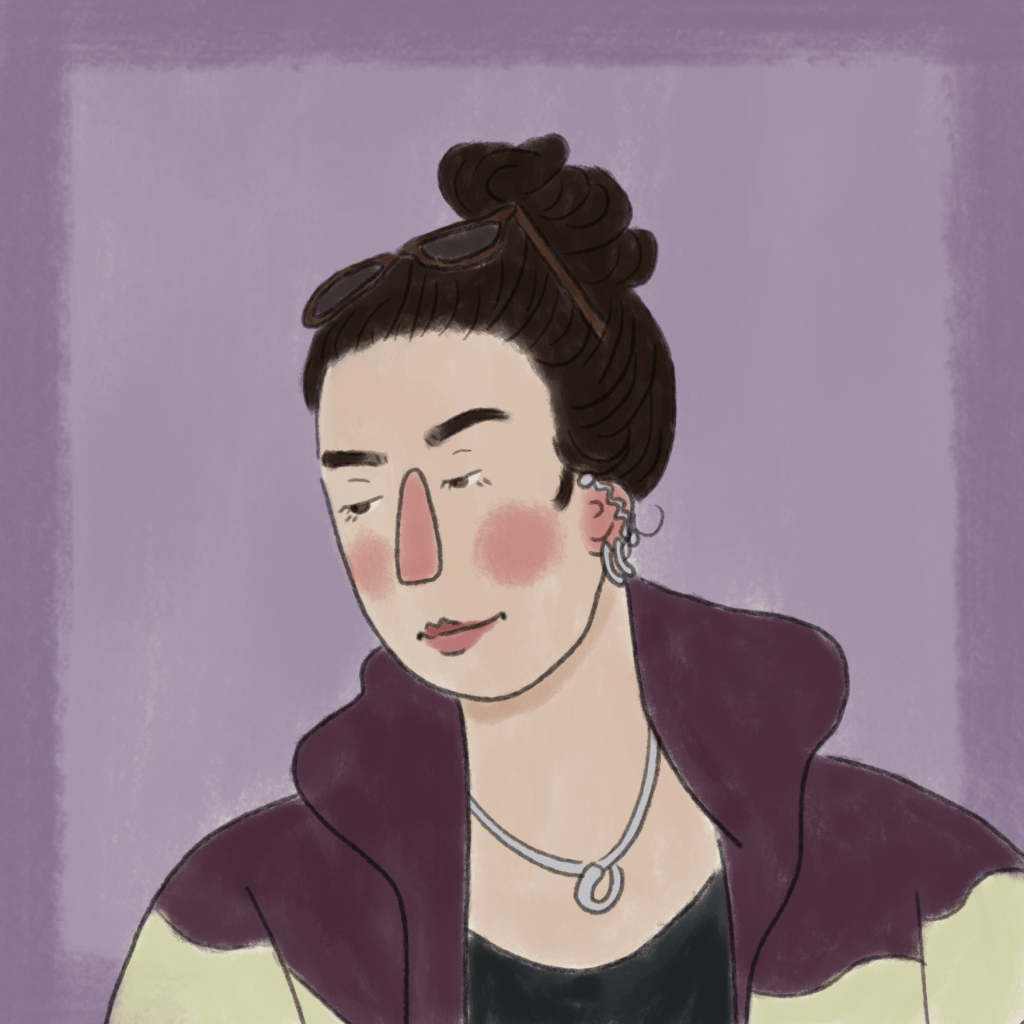
ABOUT THE AUTHOR
Viola Becagli is an MA student at Utrecht University, currently following the program ‘Literature Today’. She completed her BA in Rome studying Spanish & English language, and literature and translation, focusing her studies on the changes following the transposition from novel to movie.

