
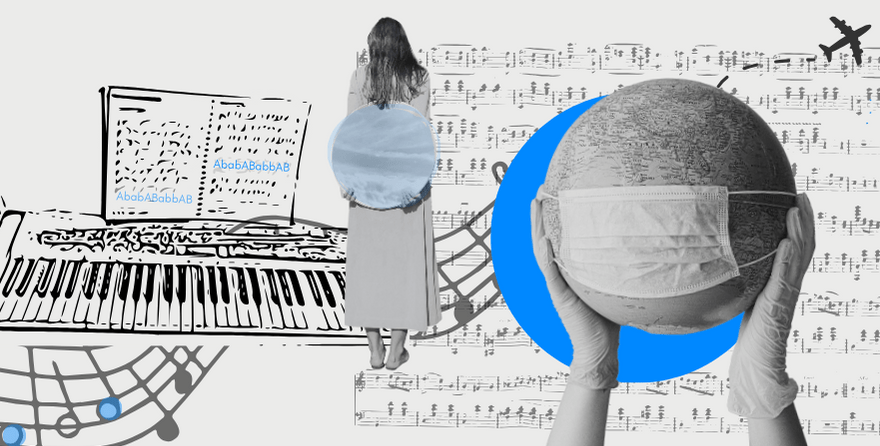


A creative-critical review by Lottie Gale
Since the year 2020, we have all been performing. We are walking reconstructions of our pre-pandemic selves. Amid lockdowns, blue masks and sanitising stations, our lives were put on pause. When it was time to press play again, the world had refracted into a spectrum of ends (people died) and beginnings (dolphins swam in the Venice canals). We catch glimpses of what could have been in the streetlights that line the path we now take.
Deborah Levy, acclaimed novelist, memoirist and two-time Booker Prize nominee, turned to the world of classical music to explore her notion of identity being “self-composed”. Her ninth novel, August Blue, is a lyrically conducted dream sequence that attempts to pull together the pieces of a life, interrupted.
Though the “Sars-CoV-2 Rapid Antigen Test” is jarringly namedropped once or twice, August Blue’s pandemic does not dwell on the intricacies so much as it swells in the background to instil a sense of unease and displacement. Levy has been praised for the way this captures something of “the dazed reawakening of the social self during that time of gradual unmasking”. However, the pandemic was not the main interruption in her protagonist’s glittering career.
Elsa M. Anderson is an orphan and celebrated concert pianist who recently dyed her hair blue on a whim. Fostered aged 6 by piano maestro Arthur Goldstein, a “short man. With complexes”, who plays a dually paternal and pedagogical role for the young child prodigy. This notion of doubles is central to Levy’s depiction of unravelling self-image. At the height of Elsa’s success, she performs Rachmaninov’s Piano Concerto No.2 at the Golden Hall in Vienna. Until she doesn’t. For two minutes and 12 seconds, Elsa’s hands (insured for millions, silkened with orange blossom hand cream) play a composition of their own. The audience is stunned, the conductor enraged, Elsa entranced. She walks off stage shortly after.
We join Elsa a few weeks after her mid-performance breakdown as she drifts between Athens, London, Paris and Sardinia – places emerging from their own disruption as quarantines lift. She recognises her failure, that she “had messed up the Rach”, truncating the Russian virtuoso’s name to assert her familiarity with his fine work. She is telling us that she is at home with such men, the greats. This is also a revealing performance of belonging: to say Rachmaninov’s name in full would be a breathless admission of what she abandoned halfway through.
Confusion about her next steps makes it painful for Elsa to face the music in full. While meandering between private piano lessons, she tries to come to terms with the unexpected notes that spilled out of her fingers in Vienna. Her hands committed an act of disobedience, but Elsa is not sure against whom; the conductor is their ostentatious master, but she herself is their corporeal possessor. She seeks new avenues of self-expression. But is it too late?
A key lesson that Elsa learns from her own identity troubles is not to impart them onto others, perpetuating the cycle. This is most apparent in the didactic traits she inherits from her high-pressured experience as a child prodigy. She narrates a lesson with her favourite pupil:
When I wanted to correct a mistake, I lifted their wrist off the keys. You are stealing my hand, Marcus said … I made a decision to never do that again.
Elsa sees this kind of interruption as perversion – she intervenes because of her role as teacher, but who knows what the child could have created if not cut off? This mirrors the disruption of Elsa’s own career, to the powers that forced her hands off-script, and the powers that ultimately reigned them in after two minutes and twelve seconds. Can impulse be rationalised? Her decision to “never do that again”, and her affection for this particular pupil, “I felt at ease in their company”, suggests she is gaining back some freedom. Is this a result of distancing from the version of herself who performs on a stage, being conducted? Levy leverages interruption in the composition of her writing: being thrown off course is sometimes an opportunity.
Don’t be mistaken – Levy ensures that Elsa’s journey towards “a new composition” is not entirely internalised, this is not a novel about a celebrity’s lonesome fall from grace. Elsa has company in the shape of a mysterious doppelgänger that follows her around the world. She is aware of her mirrored self from the opening scene in Greece, when she watches the woman buy the last two mechanical toys at a market stall. Here begins the imagined dialogue between Elsa and her double, in the apt form of a musical refrain:
Maybe you are, she said.
Maybe I am what?
Looking for signs.
What sort of signs?
Reasons to live.
The seemingly telepathic call-and-response between the women is a gift from Levy to her readers: through these refrains we edge closer to understanding the rebirth of identity that is taking place. This is a gift that keeps giving – it is also where Levy’s wistful style with its pauses, spurts and stutters, is most rich and illuminating. In a novel preoccupied with displacement and disruption, the use of the doppelgänger serves as a firm focal point for Levy to explore what it looks like to shed, and construct, a version of the self. The alter ego means Elsa is not reforming from scratch – she holds up a time-elapsing looking glass for the trauma of Elsa’s childhood and the glimpses of the woman she is yet to become.
Outside of Elsa and her “shadow-self”, doubleness begins to dizzy Levy’s narrative. Her writing loops around itself and at times gets tangled in its own insistence on musicality – people can be “perfectly composed” and padlock combinations become broken melodies, “Try two-four-eight-six”. Her trademark resonance of objects, what Filgate refers to as a “throughline in Levy’s work”, does not escape this lyricism. Elsa’s friend Marie, having just attacked a speeding motorcyclist, hugs Elsa goodbye and walks off “with the bloody ring in her pocket”. The scene abruptly shifts to Elsa making tea, alarmed by the heat from “the tiny ring of gas on the hob”. In a short paragraph break, a couple of lines, Levy is drawing a ‘ring’ across time. Small shapes act as beats in the rhythm of Elsa’s observations, much like the parallels between the two doppelgängers. Levy plays on images that might otherwise be abstrA-
AbstrA? Ab# ABabABabAB BBBaaa AAABBB
Sorry – images that might otherwise B AbstrAct or arbitrA-
A#
My hands converge to play the black and white keys. How is it that a Dell Inspiron 7500 transforms into a Yamaha U1? I type A for abstract and a low hum rings out. The white, stencilled laptop keys are worn, but now the ivory chimes in a tuneful melody as I glide my hands across the octaves of the QWERTY pad. With each stroke, the 1082 words of my August Blue review stretch into lines of sheet music. The pixels of small, black letters bleed into the ink of minims, quavers, treble clefs. All of which I play, my fingers moving with deft pace when moments before they faltered on how to start the next sentence. A bum note. CTRL + Shift and it becomes C-sharp. In the distance, I think I hear the rapid clicking of keys – typing, typing – but no, it is my metronome – ticking, ticking.
What possesses these hands which, I’m sure, were growing stiff as they approached that halfway-through-the-wordcount slump? My creation crescendos. I slide my feet forward, angle my toes towards the base of my instrument, then rush down on the smooth pedals. What pedals? My shoes unceremoniously meet the floor beneath my desk, next to the bin (top of the pile: rejected notes on Levy). My piano has an off button, it protrudes amid this interlude. I press it with purpose, maybe if I push it hard enough the polished wood of the piano will reconfigure to the chrome edges of my laptop. I have an essay to finish. It is no use – the black and white keys taunt me. I slam closed the lid of my piano – the glowing screen flickers off.
Time for a break – I walk to the kitchen in search of coffee. Someone is boiling the kettle, the hob ring beneath it glows red. I think of the bloody ring in Marie’s pocket. I think of the ring of gas on Elsa’s hob. I shake out my fingers, trying to expel the trance they were under, but when I stretch them out the silver bands embellishing each digit twist. Dizzied vision blurs silver rings, hob rings, coffee stain rings. Levy’s doubles have ricocheted their way into my day, and maybe coffee will not shake that, but fresh air should.
Walking down the stairs, I think about how when you love someone, you see them everywhere. Your eyes become dartingly distracted by imagined glimpses of them. I grab my keys, paying no attention whatsoever to the silver loop of the keyring, and open the door. Outside, I breathe in the cold air to clear my mind – what Levy would call “an impersonation of self-composure”. I decide I will take my bike. My remaining 1000 words will be better after cycling, and anyway my laptop is now a piano.
I think about my birthday last year. A friend bought me a Daunt Books bag. I had never heard of the place, to her surprise. The next day on the Tube I saw one thousand people with Daunt Books bags. It has a name I think, the Frequency Illusion.
My bike waits amongst its two-wheeled friends. The pairs of wheels spin and the silver spines glint. Levy’s cycles interrupt my cycle. I consider, was Elsa seeing herself everywhere because she thought of herself, frequently? An obsession over a broken identity allows us to identify how Elsa feels about the adult, and artist, she is becoming. I rub my eyes and suddenly I am standing in a jewellery store. Gone are the bike wheels slotted in racks – now rings, silver rings, nestled side-by-side as far as I can see. Metamorphosis: Ovid, Kafka… Levy?
Elsa strives for “a mental impression of harmonic combinations”. The thoughts that plague us will not relent until we address their intrusion. I think we should finish what we started more often.
I circle back inside.
Cautiously, I approach the closed machine on my desk. Upon touch, will it spring back into that strange, mutant instrument? I stopped piano lessons aged 12 because the teacher described my pinky fingers as unobliging. You have an essay to finish; these hands are yours – they will type if you conduct them so. I prise open the lid and the Word document glares back, the screen familiar once again. Lines and bars of music have returned to the breaks and marks of words. And to my surprise, there are 2000 of them. Wordcount reached.
An interruption became inspiration. Levy told me it would.

ABOUT THE AUTHOR
Lottie Gale is an MA ‘Literature Today’ student at Utrecht University. She is fascinated by the experience of being a reader, particularly considering the power of paratextual elements. Her previous research focuses on this idea, including her most recent discussion on ‘Judging a Book by its Cover: Advantageous Eponymy and Active Titles’. As a film enthusiast, she also hopes that Dutch subtitles during cinema trips here will develop her currently extremely poor knowledge of the language.

