
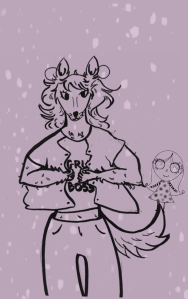
Fear, Fur, and Father Figures
When the Wolf Comes Home
By Hana Noshie
The first time I encountered a werewolf, I was six years old and watching Wizards of Waverly Place. This shapeshifter was Alex Russo’s (Selena Gomez) werewolf boyfriend Mason Greyback (Gregg Sulkin). Thereafter my obsession with the supernatural and the unexplainable began. This naturally escalated into devouring Stephen King novels and age-inappropriate horror movies, as did every other preteen. I loved and still love being scared. When Nat Cassidy’s fifth novel When the Wolf Comes Home (2025) came out, it was named “brutal and terrifying” by writer and horror connoisseur Becky Spratford. It felt imperative to hunt down a copy. And whereas Mason Greyback previously lived in New York, in Cassidy’s latest novel the werewolf has come to Los Angeles.
Nat Cassidy’s history with horror and the macabre long predates his writing career. In an interview with Rick Clifton, Cassidy emphasized the significance of the horror genre in his childhood. Cassidy explained that he was “a deeply sensitive kid” who was drawn towards all things scary, yet also terrified by them. His mother was a big Stephen King fan, with Cujo a part of the family literary canon, hence young Cassidy became a constant reader.
Cassidy left his home state, Arizona, for the Big Apple, with a suitcase full of larger-than-life dreams (or nightmares). He started off as a horror playwright with years of theater experience. In 2013, Cassidy began his screen acting career, appearing in shows such as Law & Order: Special Victims Unit, Quantico, and Blue Bloods. In 2017, in line with the rest of his oeuvre, Cassidy took to writing horror novels.
His debut novel Mary: An Awakening of Terror came out in 2022, effectively putting him on the map as a “master of horror”, a title given to him by the renowned horror author Ramsey Campbell. Just two years later Cassidy won the Bram Stoker award for his novella Rest Stop, a punch-packing story about a musician whose stop at a gas station turns into a bathroom break from hell. Safe to say Cassidy is a seasoned veteran in horror.
The wolf and his home were inspired by the promo for the 1995 CBS programme “American Gothic”, specifically the shiver-conjuring line: “someone’s at the door”, that was sure to scar American children for life. When the Wolf Comes Home was the brainchild of 13-year-old Cassidy who wrote it soon after witnessing the horror of the CBS promo, but abandoned the project after a few chapters. More than two decades later, he picked up the unfinished parts, variously inspired by Terminator 2, Firestarter, and Superman 3, and began molding them together. These inspirations shine through the now best-selling thriller.
Jess, or Jessa, is a 31-year-old struggling actress: instead of landing a role on a TV show, she works the graveyard shift at Poppy’s, a grimy highway diner. When Jess resolves to quit her miserable waitressing job, her problems grow exponentially larger than booking her next acting gig. Instead of starting her new life, Jess finds herself the unconventional guardian of a child she’s never met before, one whom she comes to call “kiddo”.Kiddo is on the run from a giant bloodthirsty werewolf, cut from the fabric of nightmares. And by the way, this werewolf is also his father. As they run, as if things can’t get any worse, the wolf reveals itself to be something more horrifying than a moon-tethered shapeshifter.
What Cassidy accomplishes in When the Wolf Comes Home is more than a conventional werewolf novel. With respect to the werewolf essentials (e.g. The Cycle of the Werewolf), Cassidy’s wolf is not just some guy who had a freak encounter with a werewolf, who now transforms once a month, ripping through an endless supply of red flannels. Rather, this thrilling paranormal work realizes contemporary horrors; in place of vampires, demons, and sirens, Cassidy confronts his readers with things truly scary: failure, grief, and bad parenting. Of these fears, the failure of the father figure is the most prominent throughout the novel. Cassidy portrays the father as a shapeshifter by nature, always transforming between the protector and source of fear, often imperfect. This dynamic is plentiful throughout the story, appearing in Jess’s feelings towards her absent father, the boy’s extreme fear of his father, and in the afterword about Cassidy’s own late father. In each of these cases, fathers attempt – and fail – to protect the people they love. Hell, the first chapter is titled “ALL DADS ARE MOTHERFUCKERS”.
“In place of vampires, demons, and sirens, Cassidy confronts his readers with things truly scary: failure, grief, and bad parenting.“
Jess’s father-daughter dynamic is complicated. For starters, we are introduced to her dad through the name of her improv group “Daddy Shoes” (a homophone for Daddy Issues and a compromise from the group’s initial proposed name, All Dads are Motherfuckers). Jess’s father left her and her mother when Jess was six and seemingly had no interest in Jess thereafter. For a long time Jess resorts to not thinking about her father, but when he dies unexpectedly, he begins persistently haunting her thoughts. As the story progresses Jess comes to learn bits and fragments about her father: where he lived, what he did, and finally why he left her. What really horrifies Jess is the discovery that she is not unlike the man she hates. Like her father, she fails constantly in her new shape as the boy’s protector. When she royally screws up, her inner monologue bitterly reminds her that she’s her “father’s daughter”, seemingly the worst qualities of his were the only ones she inherited.
The boy’s father, the wolf, is a physical manifestation of the worst of fathers. Jess and kiddos’ adventure begins with the boy running for his life from his four-legged father. The wolf fails miserably in his role as a father: he is terrifying and temperamental, he prevents his son from getting an education, endangers him by turning into a bloodthirsty wolf, and is so inattentive that his son goes missing for several days, during which he is essentially successfully kidnapped by a stranger. Despite all of this, kiddo misses his dad. Their problematic relationship resonates with the father-son dynamic of Stephen King’s The Shining, as the line between protector and predator blurs.
Cassidy, in the book’s afterword, explains that each of his books is in some way related to his family. While Mary was for his mother, and Nestlings for his wife, When the Wolf Comes Home pays homage to his late father. While this story is not directly about him, Cassidy explains that his dad was a shapeshifter as well. His life was made up of a plethora of identities: a teacher, a detective, a medic, a scholar, a politician. Cassidy admits that his father was imperfect, and one shape he could have been better at was that of the father. For a long time he wrestled with the parts of him that were reminiscent of his dad. In time, Cassidy came to know his dad as the sum of his shapes and as more than a bad parent. This realization brings about the thought: “Maybe the true horror of the werewolf is that the change is never permanent”. This speaks directly to the instability of the fathers in his story, the instability is scary as the worst of your father is only one part of him, and you cannot be sure which version of him you are going to get. Therefore, what Cassidy explores in this work is a horror familiar to many readers, complicated fathers, and combines it with the familiarity of supernatural scares.
While the descriptions of gore and monsters of this book reveal a longstanding relationship with the genre, its close engagement with fear as a feeling and as a thing which looms over the characters is what makes this work original. Fear is a central theme to Cassidy’s work; it transforms the characters and changes the fabric of their reality.
In the case of childhood fear as manifested in kiddo, it’s tangible and fantastical. It often comprises monsters, scary movies, graphic Halloween decorations, the big bad wolf, and the dark. In comparison, Jess represents the very different fears of an adult; she is afraid of catching bloodborne diseases, failing to protect the little boy, and of being like her deadbeat dad. Jess reflects on this difference between herself and the boy, concluding that “when you reach a certain age you stop calling it fear and you start calling it anxiety – but it’s still the same thing when you’re awake in the dark”. There isn’t really a difference between them at all, her fears are not unlike those of the boy, they’ve simply transformed. Instead of living under the bed and in the dark, they reside in your bank account and in your head. Despite their differing phobias, fear motivates Jess and kiddo’severy move, both strengthening and breaking their bond while driving the plot rapidly forward. This work highlights fear’s ability to change people, asking “who do you become because of fear?”. In the case of Jess, it pushes her to shapeshift, shoot a police officer, flee across state borders, take on a parental role, and shoplift at a Target.
Jess is a hilarious, rough-around-the-edges character. She’s an aspiring actress who has been waiting for things to pick up with her career for years, and in the meantime her inner monologue consists of incessant whining. She is annoying, suffers from low self-esteem, copes with awful situations with even more awful jokes, and spends a lot of time pushing down her childhood traumas. However, what makes her annoying also makes her extremely relatable (and in turn likeable). Readers are able to see themselves in Jess with how reasonably she responds to violence and monsters, her most used phrases in the face of danger are “what the fuck” (which she says more than 19 times), “gonna die” (14 times), alternatively “what the fuck, gonna die” (2 times) or “fuck” (too many times to count). Cassidy spotlights Jess’s imperfections time and time again, for example, on several occasions she deeply considers abandoning the five-year-old boy and driving far away in order to save herself from the wolf. She shrugs off these intrusive thoughts, partially redeeming her character, but they horrify Jess. It’s these insights into her mind that make her more real and afraid than the common trope of overly-brave horror heroines, making her a breath of fresh air within this genre.
What Cassidy does well, he also does not so well. Childhood fears are captured amazingly in the boy, and things that terrorize him are familiar to readers. However, his age, decidedly five years old, is not captured with the same understanding and nuance. Kiddo is inconsistent, mispronouncing fireflies as “fih-fwies”, but at the same time passing moral judgement on himself and Jess, concluding that at his core he is evil. It can be argued that kiddo’s complete lack of awareness of the world around him/stunted development is due to his previous upbringing as a recluse. Even so, his oscillating between these two states, either too mature or too toddler-like, makes his character feel underdeveloped in comparison to Jess and more like a broad representation of childhood fears. This breaks up the flow of the story and gives the reader whiplash, as his behavior lacks the degreeof consistency necessary for realistically depicting young characters. The issue of irregularly written child characters is not uncommon in horror, nor in many works of fiction, and yet it is disappointing, considering the careful attention to detail the rest of Cassidy’s work displays. Despite this, Cassidy delivers a brilliantly haunting narrative.
What makes When the Wolf Comes Home a quintessential piece of horror is not just the beautifully described gore and the monsters that make your skin crawl, nor is it that reading it likely results in a few nights’ sleep with the light on. While that’s all part of the magic, Cassidy pairs gore and monsters with the horrors we carry every day: fear, fatherhood, and the realization that we may be more like those we fear than we thought.
ABOUT THE AUTHOR
Hana Noshie (She/Her) is a Dutch-Lebanese MA student of “Literature Today” at Utrecht University. Her research interests pertain to Middle Eastern literature and postcolonial identity. Outside of academia, Hana is an enjoyer of slacker rock and reality tv.
 RevUU
RevUU 