
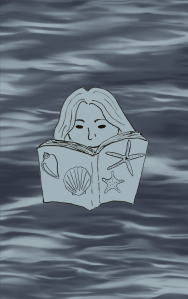
The Boy from the Sea and the Flood of the Green Wave
By Eva Bleeker
The Green Wave, a term coined by the L.A. Times to describe the rise in popularity of Irish culture, has engulfed us all. It is undeniably evident in our local bookshops, having flooded the shelves with names such as Claire Keegan, Paul Lynch, and Sally Rooney. The 2023 Booker Prize also showcased this “new golden age of Irish fiction” by including 4 Irish authors in its longlist of 13 novels. When debating what may explain this Irish literary luck, no clear answer reveals itself. While Rachel Connolly refers to the country’s “long history of storytelling”, Max Liu describes its “supportive literary community”. The supposed literary secret of the Irish appears to be their culture, whatever this may entail.
Ireland has a rather extensive literary history despite the size of the country and its population. Today’s authors live in the shadows of great names like Jonathan Swift, Oscar Wilde, William Butler Yeats, James Joyce, Edna O’Brien, and Seamus Heaney, to name a few. What then defines “Irish writing” is somewhat elusive and ungraspable, but some shared characteristics are the sober wit of the Irish, their irony, and their nostalgia “for a traditional world lost or for an ideal world gone wrong”, as Brittanica describes it.
Garrett Carr’s adult fiction debut, The Boy from the Sea, embodies this intangible Irishness. It conveys the Irish sense of community in a village’s response to the infiltration of their close-knit ecosystem by an infant abandoned on their shore. Spanning two decades, The Boy from the Sea relates the story of Brendan, who was found in a barrel on the beach of Killybegs in 1973 and later adopted by the fisherman Ambrose Bonnar and his family. As the village remains somewhat mystified by this boy over the course of his youth, it finds itself turning to the young Brendan for support during the times of change that the community faces as modernity creeps in. Ambrose’s and the rest of Killybegs’ enthrallment with Brendan puts a strain on not only Brendan’s development as he struggles to find his place in the community he has entered, but also on his relationship with his new brother, Declan. Through its inventive use of the first-person plural narrator, Carr’s novel manages to capture how this community responds to changes thrust upon it in a familiar voice that evokes a sense of traditional Irish storytelling.
“Through its inventive use of the first person plural narrator, Carr’s novel manages to capture how this Irish community responds to changes thrust upon it in a familiar voice that evokes a sense of traditional Irish storytelling.”
After his non-fiction work The Rule of the Land: Walking Ireland’s Border and a series of Young Adult books, Carr’s adult fiction debut positions him at the heart of the Irish literary tradition through its unique narrative voice and ability to capture the essence of the Irish. The narration of the communal voice shifts the focus of the novel from Brendan, the seemingly obvious protagonist, to the entire village. Whereas the typical Bildungsroman follows the coming of age of a single main character, this novel captures the development of a society not attempting to find itself but trying to remain true to its roots despite imposing forces of change.
The plotline of the Bonnar family is skilfully intermixed with the community’s development. As Ambrose is in a period of economic prosper due to his success out at sea, the narrative voice analyses the town’s changing vocabulary as it comments on the new, undeniably larger houses in town that “made it difficult to pretend we didn’t live within social stratifications”. The novel portrays Ambrose and the Bonnars’ story as worth telling, not because of their unique situation, but notably because it is one of many. The introduction of class into this community is a direct effect of modernity entering a society built on tradition and familiarity. Carr has thus managed to translate the town’s discomfort in being confronted with its enforced change through a communal voice that supposedly speaks not only for the people of Killybegs, but for all of Ireland.
Carr strengthens this perspective by invoking an ancient storytelling technique. This “we”-narration namely calls to mind the chorus of ancient Greek tales, which further cements Carr’s representation of the Irish as traditional folk, wary of change. The chorus was an integral part of ancient Greek theatre, consisting of a group of voices commenting on the main actions of the play. As Lily Kass explains, the chorus exists in a liminal space “between observer and participant”. An example of this is the chorus of the women of Corinth in Euripides’ Medea. So, too, impose the voices of Killybegs on the tale of the Bonnar family with their sober observations and witty commentary. In employing this device, Carr situates The Boy from the Sea in a rich, historical tradition of oral storytelling. With this come notions of an old culture that has persisted throughout time.
Another strategy that Carr uses to situate his novel in a lineage of Irish culture is his mythicisation of Brendan. The novel’s title alone conjures up connotations of Irish folklore, myths, and legends, likening Brendan to figures such as Fionn McCool, Cuchulain, or the Selkies. The novel’s narrative voice initially approaches Brendan’s mythical origins of floating in from the sea, with which the Irish feel a strong cultural as well as economocial connection, with some scepticism: “Our town’s dominant religion required us to believe in miracles, but we didn’t”. As Brendan grows older, however, a lingering fascination remains, causing the people of Killybegs to turn to the young boy with their troubles. He would then give out “blessings”, placing his hand on the troubled folk and speaking some words of comfort and wisdom, in so far as a nine- or ten-year-old has any wisdom to bequeath.
The comfort the town appears to find in Brendan’s presence contradicts the sensibility in which they pride themselves. Can we blame them, however, for clinging to the consoling folkloric images that retain the very Irishness that modernity threatened? “Jobs were scarce and the youth were emigrating as fast as we could raise them, add in the cost of living and the threat of nuclear war and it’s no surprise Ireland was grasping for miracles”. Besides, where the more excitable people from other parts of the country claim to see statues of the Virgin Mary show signs of animation, at least the town of Killybegs did not make “a big show of it”. Clinging to traditional icons of “Irishness” functions as a coping mechanism, or even a form of resistance against change. It helps that it is easier to admit one’s worries about the future to this boy from the sea than it is to truly reflect on your situation and feelings yourself.
“Clinging to traditional icons of “Irishness” thus functions as a coping mechanism, or even a form of resistance against change.”
What this communal voice namely also permits is for the collective “we” to mask the vulnerable individual “I”. While the narrative voice has access to quite a lot of what is happening inside the Bonnar household, as is typical of a close-knit, perhaps somewhat gossipy, community, this form disallows for deeper introspection. This appears, however, not to be a fault in Carr’s style, but rather an intricate stylistic choice to indicate a greater social issue. These Irishmen are not ones to psychoanalyse themselves: “we all had bills to pay and no time to sit around thinking about ourselves like we were fascinating conundrums”. In an interview with The Bookseller, Carr indicates his wish to counter some of, for example, Sally Rooney’s characters, “emotionally articulate people – women, mostly”, by writing about the people (men, primarily) who do not possess the vocabulary necessary for this eloquent self-analysis.
While the communal narrative voice saves individual characters the need to dissect their inner workings, it still manages to analyse the way of the Irish in an almost anthropological manner. Take, for example, the novel’s “note on our use of the word ‘grand’”: “‘Grand’ was how we acknowledged that something wasn’t good or great while also saying nothing could be done and there was no point going on about it”. Instead of mulling over their worries, the Irish mumble a quick “it’ll be grand” and that is that. In these instances, the narrator appears to be sitting in a bar, chatting to a visitor of the town and explaining their ways for the outsider’s sake. The Boy from the Sea attempts to capture a people, a time, a culture. It illustrates the Irish to the curious foreigner, presumably speaking to the new audience drawn in by the Green Wave and taking this opportunity to properly introduce the simple, sensible, yet caring character of the Irish to the inquisitive rest of the world.
Even though the novel covers a long period of time, it does so at quite a slow pace. With its intricately detailed descriptions relating the technicalities of different fishermen’s boats and sea routes, the narration of The Boy from the Sea has a quality reminiscent of Derry Girl‘s uncle Colm, a notoriously dull character from the tv show that plays a huge part in the Green Wave. Uncle Colm constantly goes on tangents, trapping his conversation partner in a monologue they desperately want to escape with his sleep-inducing, monotone voice and painstakingly slow storytelling. While this is not as drastic in Carr’s novel, the slow evolution of the plot, which includes little character development or resolution in the conflict between Brendan and Declan until the very end, does conjure up the feeling that we as readers are trapped in a Colm-like conversation with our plural narrator. The pace of the plotline is also reminiscent of the creeping encroachment of modernity upon Ireland; the changes might seem subtle and slight, yet major shifts occur in the grand scheme of things.
Like Uncle Colm’s ramblings, The Boy from the Sea may be slow at times, but if one is willing to take the time to listen to this narrative, it reveals quite fascinating tales. In between the many names and faces of the town, the intricate explanations of the fishing industry, and the day-to-day lives of the people of Killybegs, Carr manages to capture the fundamental workings of the Irish: “Life was a sort of procession and we all marched in it together, you had to keep up. The truth was we didn’t give each other much time, we didn’t give ourselves much time, we didn’t like to go on about things”. Perhaps the truest analysis of the Irish is achieved through this somewhat superficial method, for that is how they approach life themselves.
The novel therefore does not begin or end with Brendan or the Bonnar family. It is a tale of a community, of a culture, that is part of a much longer Irish tradition and will persist into the future for many years to come. The town will continue to “[remark] on the annual cycles”, and “[w]e might remark on the town’s slower cycles too: alternative lifestylers came and went, and whenever a not-working man passed on or came to prefer staying indoors another not-working man would appear to take his place on the wall of the diamond. Meanwhile our youngsters grew and got jobs, went out the bay or perhaps left us entirely”.
Whether it is in the fishing industry or in conventional styles of storytelling, Carr has encapsulated the disobedient spirit of the Irish in their insistence on having their traditions prevail in modernity. This is a novel submerged in Irishness. If anyone has any worries whether the Green Wave will change the Irish literary tradition, Carr is here to reassure us: It’ll be grand.

ABOUT THE AUTHOR
Eva Bleeker (she/her) is a literature enthusiast currently doing the Master’s “Literature Today” at Utrecht University. Her Bachelor’s in English Language and Culture has cultivated her interest in the capacity of literature to expose systems of power, as highlighted in her thesis on the construction of race through a lens of Lacanian and critical race theory. The time she spent at Queen’s University Belfast also sparked a special interest in Irish literature. In her free time, she writes and posts literary fiction book reviews.
 RevUU
RevUU 