
Hold On Tight, Spider Monkey and After-Man
By Paula Kubacka
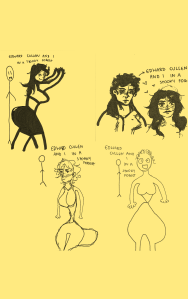
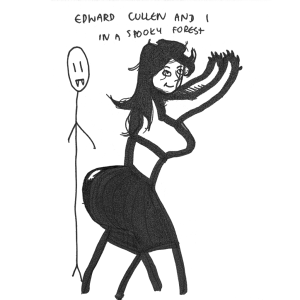
In this dream, Edward Cullen stands right behind me in a spooky forest. He leans in, though he doesn’t touch me, and whispers, “Say it out loud”. I know what he wants me to say, and so I say it, not accusatory but as if to cast a curse: “You are a vampire”.
In another dream, I am forced to become a dragon rider to participate in a war, just like in the past, when I was sold to One Direction and had to leave home as well. I have many dreams like that, mostly of men who are dangerous yet alluring, who want me and care for me in their own twisted ways. In many of those dreams, something stands in the way of getting together with my man; sometimes they’re in a high position of power (King of Elfhame), or are abusive towards me (King of Elfhame). Still, they love me, but their nonchalance does not allow them to show any true feelings because of the complicated past™ (King of Elfhame).
This popular dream of forbidden romance often portray male love interests as hot, sarcastic, almost seven feet tall (Xaden Riorson), sometimes with a hairless tail (King of Elfhame), or sparkling skin (Edward Cullen). Of course, when I was younger, I also had those dreams; they started pretty early, especially since I got unsupervised internet access. Back then, I was either kidnapped by the mafia led by Harry Styles, or later, when I discovered gay people, sorry, the Marauders, I stopped participating in the dreams but rather watched from afar. People before me had those dreams as well, like when Mr. Darcy came into being, or even before that, when Orpheus was guiding all of us from the bottom of Hades and needed to turn around to prove his love to us.
In the modern day and age, the most popular ̶d̶r̶e̶a̶m̶s̶ dark romance fantasy BookTok books are being written by… female religious authors. This particular change, especially amidst the current political climate, is noteworthy for two reasons. First, those dreams of love slowly started to intensify – the intended audience got hooked on the promise of forbidden, complicated, toxic-but-full-of-love romance. Second, those fictional men at some point stopped being human and started resembling a religious figure.
Romance, from an unacclaimed and disregarded form of writing (early novels written by women), or privately written and community-distributed (fanfiction), has become a best-selling genre. Understanding what major names secure the position of romance right now requires actually bowing (or blaming) towards the Mormon community. To paint a good picture: Stephenie Meyer, a Mormon who writes chastity porn; Rebecca Yarros, a Mormon who publishes the most-anticipated dark fantasy romance of the last couple of years with an unexpectedly sex-positive perspective; but also the rumoured Mormons, such as Anna Todd (although unconfirmed, she is never escaping this allegation, just like she is never escaping the lawsuit from Harry Styles, who “inspired” her to write After). The bow is not only towards the romance genre, as Mormon men are also acclaimed in the fantasy/sci-fi genre (Orson Scott Card and Brandon Sanderson, or the ex-Mormon James Dashner), so why have so many dreams about Mormon romance fantasy in particular?
Because, in those carefully curated dreams aimed at the female audience, they do not dream of men but rather of a god.
Let me clarify my point. The self-insert fanfiction writing process about god comes not from love towards religious figures, but from a need for something men cannot provide – something that I call (in alignment with gender performance, which is establishing gender through repetitive actions) an after-man – whose love and devotion match the love and devotion of a spiritual guide or saviour. The after-man here works as an entity that exists within (yet beyond) traditional masculinity, hiding a conservative performance of his gender under the plausible deniability of liberal ideals.
This fictional after-man entity has classic characteristics of a man; he performs his gender accordingly through a multitude of ways, and on top of it all, the plot and main female character utilise him as a sort of medium that guides and accompanies. This after-man, then, must exist solely for the purpose of being a love interest, just so he can attend to the main character explicitly, without fail. A great example of this would be the male lead of My Oxford Year (2025), who does not possess any individual personality traits, passions, hobbies, friends, or female colleagues (except for one that was used as a jealousy trope). Other noteworthy examples: Beautiful Disaster (2012) by Jamie McGuire (not rumoured to be Mormon, but with controversial stances on vaccination), Purple Hearts (2017) by Tess Wakefield (not rumoured to be Mormon, just wrote military propaganda), and, of course, the aforementioned After.
In this recent dream, though, the after-man of my dreams is not only a guru whom I follow but also possesses… an atypical stance towards sex. This dream is obviously about the best-selling, latest BookTok romance fantasy trilogy written by rumoured Mormon, Rebecca Yarros. Regarding this matter, in the Fourth Wing (2023), the first sentence of acknowledgements is a thank you to “Heavenly Father for blessing me beyond my wildest dreams”, so I’m not sure whether fans wish for Yarros to take a public stance or just write Mormon on her forehead.
The after-man in Fourth Wing, oh, if you have not read that book, you are not ready. Of course, the reader is met with a four-paragraph-long description of his looks as early as page 29: “He’s the most exquisite man I’ve ever seen”. Good start to this dream, and so I continue to page 30. “Good gods, I don’t even reach his collarbone. He’s massive. He has to be more than four inches over six feet tall”, and “Flaming hot. Scorching hot. Gets-you-into-trouble-and-you-like-it”. The looks of this after-man, Xaden Riorson, are typically what the designated straight female audience likes; he’s sarcastic and aggressive. Even though they’re enemies at first, he obviously wants Violet. His masculinity is established early on, along with blatant descriptions of his looks, generic enough that the reader is free to dream of what they consider attractive.
Then, in the second book, Iron Flame (2023), we move towards their established relationship when he says, “‘But I’m begging you, Violet. Don’t offer me your body unless you’re offering me everything. I want you more than I want to fuck you. I want those three little words back.’ He’s not asking to hear that I want him. He wants to hear that I love him”. Here, the heteronormative and sex-compelled societal norm strengthens. The after-man establishes the need for sexual intercourse, yet resigns from it in favour of proving his undying love. This portrays sex as something earned, or rather as a natural consequence of love. Therefore, the after-man, a spiritual guide, represents the purity of true love, which Christianity favours, and thus forbids Violet from sharing one bed to not fall into temptation. Both Xaden and Violet, though both of them had sexual encounters with others, agree to having intercourse out of love rather than lust. So, they no longer get close to each other in the second book. Violet expresses her disapproval in the narrative at least once every chapter, yet she still transforms from a sex-positive female lead into the anguished main character. Yarros channels her inner Stephanie Meyer and starts her own chastity porn: “‘I want you exactly how you are, emotions and all. I want the woman I fell for. It kills me every time I have to keep my hands off you, every night I lie awake next to you, both blessed and damned with the memory of how hot, wet, fucking perfect you feel when I’m losing myself in you’”.
“The self-insert fanfiction writing process about god comes not from love towards religious figures, but a need for something men cannot provide – something that I call (in alignment with gender performance) an after-man – whose love and devotion match the love and devotion of a spiritual guide, as well as a saviour“
This quotation (and many more dialogues that happen between those 100 or so pages) underlines the want of both characters, especially that of the after-man, who does not submit to the temptation. Why choose celibacy if they both love each other? Well, Violet and her repressed feelings towards Xaden do not allow her to admit her love, and so the tension, random and weird touches continue, just like quotes regarding what he would do if only he could actually touch her. This tension, which is rooted in the Xaden power factor (Edward Cullen was really the blueprint), grows beyond his control in emotional moments, but also in the private beliefs of the main character. Xaden’s agony can end only after a declaration of love, which would automatically lead to sex. Yarros, then, as someone with experience in matters of purity and the sanctity of sex as a means of reproduction rather than pleasure, despite her progressive façade of writing about sex at all, in contrast to the growing popularity of “clean” and “pure” romance, feeds her readers a perfectly balanced ideology. And she earns good money from it, too.
Moreover, the after-man, obviously, not only loves Violet but also presents his admiration and devotion in many scenes. In the newest book, Onyx Storm (2025), due to the special bond between Violet and dragons, she and Xaden not only share a telepathic ability but also dreams. The protagonists of Onyx Storm are therefore united not only emotionally, but also spiritually. Their bond allows them a form of understanding and communication that transcends the human dimension. Thanks to this, after-man has access to all of Violet’s doubts and insecurities – every time the heroine feels powerless, after-man enters her head and transmits his wisdom. In this situation, it is important to recognise the trend of the after-man, which largely stems from involuntary (or very fundamental, as in the case of Yarros) mystification and the consecration of masculinity, which is supposed to save the traditions of family and heterosexuality. The after-man is also a promise that relationships with unpleasant men, or men who do not treat women well, will be worth it in the future, as the after-man acts as a lifelong companion, whose life is always embedded in the main character’s narrative.
This is also a reminder of the dangerous nature of my dream. In this dream, as long as the after-man exists, he will always exist right next to you. Most things will be about him, especially the plot. Every thought you have will be his thought, after all, you have an incredible bond. Every desire you have will actually be his desire, after all, you have an incredible bond. In fact, your bond is so incredible that you could be one person, but if that’s the case, why is there so little of you in it?
One could also go further and ask what the purpose is of publishing, celebrating and encouraging young women to love these men. Then, talk about declining religious faith, an increased number of divorces, and fewer marriages; about the financial crisis, the lack of stable housing, as well as the indoctrination of young women, who are supposed to be always grateful to men who always take care of them, and make them dependent by taking on their burdens. One could then go in the direction of the distorted social value pyramid that places romantic relationships at the highest level, or the whole male loneliness epidemic through which men are fed red-pill content. All of these contribute to the economic/anti-feminist anxieties, which are then used to reinforce the romantic fantasy.
But one can also go backwards – just as ignorance towards education is going now – and say: I’m not reading all that.
Then, religious propaganda will be just a book, and this book will be sold to women under the protective layer of fantasy. Then, I might continue to dream well in today’s political climate, and wish that one day I might finally dream of waking up; of disobedience.
ABOUT THE AUTHOR
Paula Kubacka (she/her) is a writer and a poet. Currently, she’s a Master’s student at Utrecht University, where she also completed her BA in Literary Studies. In her free time, she’s focused on creating an archive containing all the people she loves.
 RevUU
RevUU 