
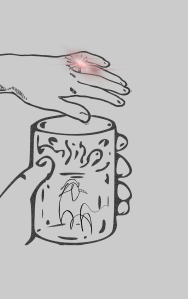
Let Me In:
A Psychoanalytical Essay on Lisa Jewell’s Don’t Let Him In
By Mireille van den Hooven
“He’s the perfect man”. A sentence that reverberates throughout Lisa Jewell’s newest novel, and something that, as we all know, sounds too good to be true.
Lisa Jewell is a mystery writer; she writes psychological thrillers, and if public opinion is to be believed, she writes them well. Her latest novel, Don’t Let Him In, tells the story of Nick Radcliff. He comes into the lives of Nina and Ash Swann, shortly after Ash’s father, who is also Nina’s husband, has tragically died. From the moment she meets him, Ash is suspicious of this charming person who seems to have a perfectly reasonable explanation for everything. At the same time, a few towns over, Martha is starting to doubt her marriage. Her husband Alistair is never around, and she feels that he is keeping secrets from her. What these women do not know, but the reader soon comes to realise, is that Nick Radcliff and Alistair are the same person. Handsome, charming, and intelligent as he is, Nick Radcliff is capable of fooling women into falling in love with and marrying him. He stays with them for several years, scamming them out of their money, before disappearing into that good night.
Nick Radcliff is a romance scammer, and he is eerily effective. Contrary to almost all the stories that we have about romance scams, this novel is partially written from Nick’s point of view. Jewell asks why someone would choose the life of a conman or conwoman and a criminal, when they have every opportunity to live a normal life. Her novel strives to give an answer to the question of why someone would treat others this badly. It also provides us with the opportunity to decipher Nick’s questionable traits, as he outwardly hides them well. Jewell uses first person narration to dive into Nick Radcliff’s psyche to figure out how people like him think and operate, both in fiction and in real life:
And I feel bad, of course I do, but that’s life. She made choices, she allowed it all to happen. I don’t want to say that she was stupid, but yes, fuck it. She was stupid. Stupid for love. Stupid for the status quo. Stupid for whatever it is that women get from having a man like me in their lives.
Over my lifetime I have developed the unique ability to see and understand within a second exactly what sort of man a woman is looking for and to offer it to her. After that it is up to the woman to set her boundaries, because if I am giving a woman what she wants, then she has to give me what I need. That doesn’t seem unfair, does it?
Although the author does not explicitly convey it, it can be argued that Nick Radcliff’s behaviour and mind go beyond mere misogyny, and that he is also a narcissist. To be diagnosed with narcissistic personality disorder, someone needs to present at least 5 of 9 criteria specified in the DSM-5: 1) interpersonally exploitative behaviour, 2) a grandiose sense of self-importance, 3) a sense of entitlement, 4) a preoccupation with fantasies of unlimited success, power, brilliance, beauty or ideal love, 5) an envy of others, 6) a lack of empathy, 7) a need for excessive admiration, 8) a belief that he or she is special and unique and can only be understood by, or should associate with, other special or high-status people or institutions, 9) a demonstration of arrogant and haughty behaviours or attitudes.
Nick thinks he has the right to treat women as walking piggybanks that give him what he wants, simply because he is better than they are. He blames his victims for falling for him and holds them responsible for everything he does. Here, the character portrays several narcissistic traits: 1) interpersonally exploitative behaviour: he takes (financial) advantage of others, and 2) a grandiose sense of self-importance. When stating that “it is up to the woman to set her boundaries, because if I am giving a woman what she wants, then she has to give me what I need”, Nick takes all accountability away from himself and places it onto the woman. It is up to her to set boundaries. And when she doesn’t, because of love and trust and “the status quo”, Nick takes what he thinks he needs and calls it “fair”. Here, Nick also shows 3) a sense of entitlement; he expects automatic compliance with his demands.
Throughout the novel, Nick calls random women, the women he scams, and their ex-husbands “stupid”. He praises himself for developing a “unique ability to see and understand”. This indicates that Nick thinks he is smarter than other people in his life, which reinforces his grandiose sense of self-importance. Nick even questions “[w]hy does this man, this small man with his nondescript face, his slack belly, his teenage demeanour… why does he have an empire? Respect? What does he have that I do not, apart from the ability to dress a crab?”. Nick is inadvertently calling this person ugly and stupid or childish, and placing himself above them by questioning what this person could possibly have to deserve money and respect, that he, Nick, does not. This portrays two more narcissistic traits: 4) a preoccupation with fantasies of unlimited success, power, brilliance, or beauty, and 5) envy of others. Nick sees himself as more deserving of other people’s money and success. In his mind, Nick works hard to give women what they want in a man and because of this, they owe him.
In addition, Nick shows 6) a lack of empathy throughout the novel: he is unwilling to identify with the feelings of others. He can recognise his ex’s feelings and says that he feels bad, but he also immediately discards them, saying; “that’s life”. His lack of empathy is most evident in the way that he creates families and carelessly abandons them.
“Her novel strives to give an answer to the question of why someone would treat others this badly.“
Narcissism is, in part, a developmental disorder; it blooms under the right circumstances, usually in childhood. We don’t know much about Nick’s childhood, except for one piece of dialogue where it is revealed that;
“Your mother changed her will because she was scared you were going to kill her in her sleep. Your parents were scared of you. You made their lives hell with your superiority complex, your insistence that they pave your way with gold.”
Assuming that Nick’s parents are not overly paranoid that she has a good reason to be scared, it is possible that Nick’s narcissism is a symptom of antisocial personality disorder, or psychopathy. Additionally, their continued (financial) coddling could have fed Nick’s narcissism.
The narrative style shifts between Nick’s first-person narration and an omniscient narrator for Ash and Martha, both of whom grow more and more suspicious of this man in their lives. The switch from first-person to omniscient narration triggers the feeling of grasping for control, an attempt to oversee the situation, to understand everything that is going on in these women’s lives, rather than an attempt to understand one specific person. Ash and Martha show themselves to be inquisitive and intelligent, as women who would not easily be fooled. Early on, Ash even brings her worries and suspicions about Nick Radcliff to a friend:
“What do you have?”
“Not much. A name. Nick Radcliffe. A wine bar that he says he co-owns. A deleted LinkedIn profile. He lives in Tooting. He’s fifty-five. He has a dead fiancée. No kids. Although I did find something in his coat pocket the other day and didn’t know what it was at first, but turns out it’s the thing that clips a baby’s pacifier to their clothes, so they don’t lose it?” She shrugs and takes a sip of her coffee. “And, oh,” she says, putting the cup back down on the table. “A poo bag, for a dog. I mean, you wouldn’t have one of those in your pocket, would you, unless you had a dog, and he never mentions a dog or brings a dog, and anyway. He’s just very… sus.”
Almost immediately after meeting him, Ash describes how Nick makes her feel uneasy and she becomes suspicious about everything. She questions his stories about his personal life, why he doesn’t have any family, why he, despite having no family, has baby and dog articles why he has a wedding ring but no wife, and why he always shows up suddenly and disappears abruptly. Martha also wonders about her husband’s past and about his disappearances. Over the course of the novel, she becomes more and more suspicious of her husband’s finances and his whereabouts. She even tries to track him with a dog tracker. In an interview, Jewell says that; “It doesn’t only happen to stupid women. … I hope the readers take that from the book.” These elements show how difficult it is to recognise a scam and how difficult it is to get out of it.
“These elements show how difficult it is to recognise a scam and how difficult it is to get out of it.“
Compared to the intensity with which the rest of this novel is written, the ending feels a bit flat. At the risk of revealing spoilers, Nick Radcliff is eventually caught by his wife as well as Ash and Nina Swann. He is confronted by them and by other people he has hurt and scammed throughout his life, including his sons. This confrontation, the thing that the reader has been rooting and waiting for, is underwhelming. Nick is initially unimpressed, thinking “[a]nd then I see what is happening here. It is a reckoning. These women and children have come together to make me atone for my so-called sins. But these women and these children—they know nothing.” Here, he once again shows a lack of accountability and empathy, and his sense of self-importance.
Martha looks at me and I see her sigh. “It’s over, Al,” she says. “This is the end.”
I frown. “The end of what, exactly?”
I hear someone tut, someone else sigh. I put my hand against my heart, and let my eyes fill with tears. “No, really,” I say. “The end of what? The end of me just trying to survive in this world? Just trying to make people happy, give them what they want?”
The sons, who the reader gets to spend no real time with, feel undeveloped in their character. It is as if they are only in the scene to give it more drama; the number of people Nick has mistreated is broad, but not deep. Many of them exist to increase the number of victims, not to add to the depth of the novel. The confrontation is short, and it ends abruptly, leaving the reader with this sense of unfinishedness, like the story isn’t done. Perhaps this also reflects real life; serial conmen get confronted without receiving repercussions. We rarely get the closure that we crave. In a novel, however, an anti-climax can easily leave us disappointed and bemused since we expect a happy ending.
The reality of the novel, which is in part based on Jewell’s personal experience, makes it exceedingly creepy and worrisome. Jewell’s writing pulls you in and has you rooting for the women, but also for the antagonist to see the light and become a better person. She digs into the psyche of a conman to imagine how people like Nick think and function and ends up with a deeply flawed and narcissistic person who truly believes that he’s not a bad person and who is given many a chance to better himself. Even though we, as the reader, get to see Nick’s real identity, his charm can fool us too, leaving us hoping for a better person to emerge. All in all, the novel brings important insights into the mind of a conperson and the mind of a narcissist, and into how people can come together and break free of the spell.
ABOUT THE AUTHOR
She/Her
Mireille van den Hooven is a writer and poet with a background in literary studies and psychology. As a critic, her strength lies in analysing characters and character relations through a psychological lens. She is interested in the art of convincing character writing, asking questions such as: how human are they? what are their relationships like?
 RevUU
RevUU 