


A PIECE BY BERKE YAZAN
“Two types of people laugh at the law; those that break it, and those that make it.”
Night Watch is an unusual book about virtue, hope, and the forces that stand in their way. It’s about the things that can be changed by a revolution, and the things that cannot. Through the filter of fantasy, the late Sir Terry Pratchett expertly uses satire and humour to explore profound themes like poverty, mass hysteria and politics. Although it was published in 2002, the book is more relevant than ever.
As the creator of the beloved Discworld series, Pratchett crafts thought-provokingabsurd stories. His sharp observations and witty criticisms roam in the fictional mediaeval city of Ankh-Morpork. Pratchett doesn’t always define this place as a city; sometimes rather as a group of people that are two meals away from chaos at the best of times. He uses the absurdities of his fantasy world as a mirror to our societies, exploring issues in gender, class, religion and much more.
At the beginning of the book, for instance, we learn that Borogravia, another country in the world of Disc, has invaded Mouldavia, a third country. Vimes asks if it’s good news and whose side they are on, a parody of the recurrent global conflicts. His subordinate replies, “Both formerly part of the Dark Empire, sir,” and “The Times said we should be supporting little Mouldavia against the aggressor, sir.” Vimes grapples with the implications. “Probably more refugees, sir,” his subordinate remarks. “What kind of refugees are we talking about here?” Vimes asks. “Mostly human, sir.” Pratchett uses the fantasy theme to make the scene’s climactic joke, “Do you mean that most of them will be human, or that each individual will be mostly human?” says Pratchett via Vimes. While opening the themes of what makes humanity really humane, Pratchett also includes a critique of social biases against refugees.
Similar to its real-world counterparts, Ankh-Morpork is mainly driven by the endless pursuit of individual profit. However, Pratchett does not necessarily argue against capitalism or any other ideologies for that matter. His main goal is to show that all societal decision-making is fuelled by collective human stupidity. In Night Watch specifically, he tries to demonstrate how unchecked and unplanned authority becomes fragile, both in the hands of tyrants and the people alike, leading to the iconic line:
“The children of the revolution faced the age-old problem: it wasn’t that you had the wrong kind of government, which was obvious, but that you had the wrong kind of people.”
Pratchett was remarkably progressive in addressing cultural inclusivity, feminism, LGBTQIA+ activism, and similar social struggles. The City Watch series of Discworld somewhat reflects this, as the Watch consists of groups traditionally marginalised in Ankh-Morpork society, including werewolves, dwarves, trolls, and even women. Of course, it’s the latter group that faces the greatest obstacles in getting accepted into the men-at-arms.
Built on these, Night Watch meets the readers as the sixth instalment of City Watch. The story follows Sam Vimes, the incorruptible and charismatic commander of the watch. In the first five books of the series, we explored the character development of Vimes from a broken alcoholic to an inspiring leader. Similarly, the evolution of the Watch mirrors Vimes’s journey, transitioning from an irrelevant laughingstock to a respected authority. Now, at its current state, the Watch stands as an effective and functional police force.
However, this story is a bit different. A sprinkle of magic, a stroke of luck, and an ill-timed lightning strike unexpectedly send Vimes thirty years back in time. These are even darker days of the Watch. However, the time travel is a plot device, not a theme. The story centers around paradoxes in people, not time.
In the past, Vimes encounters his younger self, a rookie policeman at the beginning of his journey into the realm of moral dilemmas and temptations, ones that are dangerously easy to rationalize. For the sake of the readers’ sanity, Vimes refers to him as Sam. He’s thirty years younger, and it’s his first days on the city watch. This is a good cop – not yet a good cop story. This confrontation of the past and future is accompanied by the marching sounds of an inevitable revolution. For young Sam, this will be a bloody and terrifying uprising against the tyrant of the city; for Vimes, this is just a usual ceremony to pick the next one. He puts it this way:
“But here’s some advice, boy. Don’t put your trust in revolutions. They always come around again. That’s why they’re called revolutions. People die, and nothing changes.”
Vimes looks at young Sam and sees a version of him that hasn’t spent his whole life searching for ideals to stand behind. In his own words, young Sam would need thirty damn years of being hammered on the anvil of life to become Vimes. As the narrative moves forward, we observe that the world of bribery and corruption is starting to ensnare young Sam. He sees justification for taking a bribe in his mother’s poverty and sees nothing wrong in the practices of the other Watchmen, despite their corruption. Vimes cannot stand this and takes the responsibility of guiding Sam and the Watch out of their rotten state. As a proper policeman with unshakeable virtues, he becomes the mentor of himself.
Alongside the Night Watch, Vimes discovers the current Patrician’s secret state police, the Unmentionables, who are involved in mysterious kidnappings, public beatings and unorthodox interrogations. Considering their inspiration comes from the Gestapo, it’s not hard to understand who the actual bad guys are.Like the Gestapo, resistance to these outrages is faced with a dilemma that is presented in the following quote:
“Yeah, all right, but everyone knows they torture people,” mumbled Sam.
“Do they?” said Vimes. “Then why doesn’t anyone do anything about it?”
“Because they torture people.”
Vimes has limited time to justify his authority to the watch, build a force that represents and protects the innocents, and save the people from the brink of annihilation. He and the readers know that a revolt will happen soon because Vimes has already lived through it before. And somewhere along the line, everything unfolds.
Like every civil disorder, this one starts with questionably good men with even more questionable orders. The people in charge sent a cavalry force to do crowd control, in response to a protest against the price of bread. A direct command to do what felt necessary was given to armed men on horseback, none of whom were trained in urban combat. Unsurprisingly, their mismanagement resulted in an accidental civilian massacre, claiming the lives of children and adults alike.
Pratchett draws parallels to the Bloody Sunday of 1972 when British soldiers shot 26 unarmed Irish civilians. Many of the victims of that incident were shot while fleeing from the soldiers or trying to help the wounded. The lack of accountability of the people in power, the snowball effect of a mass hysteria, and the anatomy of a city are heavily explored in this part of the story.
All over the city, there is paranoia, fear and violence, and at the heart of everything, Vimes and young Sam. The horrific news of angry crowds and burning police stations reaches them in a flash. Their own Treacle Mine Road Watch House expects to suffer the same fate. Vimes looks at the young members of the City Watch-to be. He has known their future versions for 30 years now, and he knows that under their uniform, they are just ordinary people. The motto he shares is that they are officers of the law, not the soldiers of the government, and he wants everyone to see that.
To the surprise of the people, he removes the barricades from the police station, opens the doors, lights all the lamps, and strips the watchmen of their weapons. This choice provokes some concern from his subordinates:
“No swords?” Colon burst out. “But what if a bloody great mob comes around the corner and I’m not armed?”
Vimes reached him in two swift strides and stood nose to nose.
“And if you have got a sword, what will you do, eh? Against a bloody great mob? What do you want ’em to see? Now what I want ’em to see is Fatty Colon, decent lad, not too bright, I knew ’is dad, an’ there’s ol’ Waddy, he drinks in my pub. ’Cos if they just see a couple of men in uniform with swords you’ll be in trouble, and if you draw those swords you’ll be in real trouble, and if by any chance, Corporal, you draw swords tonight without my order and survive, then you’ll wish you hadn’t done either, because you’ll have to face me, see?”
Then with a mug of hot cocoa in one hand and a cigar in another, Vimes welcomes the mob. After a hilariously witty chain of events, people agree to gather behind Vimes. In Japanese and Chinese fiction, there is often a notion that power comes from having something to protect. With the power of people he has promised to project, he decides to join and lead the revolution himself. Even though tragically, he knows from the future that nothing will change. And in the end, nothing does.
Unlike Ankh-Morpork, we live in a representative democracy. Elections are modern revolutions in a sense, and protests and strikes are the physical uprising tools left for the people. It’s interesting to wonder if we have more freedom to change our governments than a city with a self-designated Patrician. As we see in Night Watch, revolutions unite people from very different backgrounds, while elections are designed to separate them into colourful percentages until a person who is somehow worse than the previous one gets elected.
Vimes argues that the simplest way to understand how the world works is to follow the money. He knows the current Patrician and his associates are unstable criminals, the main reason for their downfall. But the key word is not criminals, but unstable. Instability is bad for business, so the associates would pick their next Patrician from a pool of stable criminals. Preferably, an individual who demonstrates exemplary patience before considering betrayal. He believes this is how real revolutions happen; with meetings in rooms, a little diplomacy, a little give and take, a promise here and understanding there. All the stuff in the streets is just a show for him. But beautifully, he joins the revolution anyway.
In the modern world, we are familiar with some of the takeaways. The wheel of democracy spins so fast that the inner circles of our governments get blurry. But despite its speed, it doesn’t seem like it will leave us anytime soon. With each passing day, individuals become increasingly categorised into uniforms, flags, and beliefs. Freedom is relative, truth is manipulated, and justice is a black box. But perhaps, it might be a good idea to go one realistic step at a time. As Vimes puts it:
“You’d like Freedom, Truth, and Justice, wouldn’t you, Comrade Sergeant?’ said Reg encouragingly.
‘I’d like a hard-boiled egg,’ said Vimes, shaking the match out.
There was some nervous laughter, but Reg looked offended.
‘In the circumstances, Sergeant, I think we should set our sights a little higher–‘
‘Well, yes, we could,’ said Vimes, coming down the steps. He glanced at the sheets of paper in front of Reg. The man cared. He really did. And he was serious. He really was. ‘But…well, Reg, tomorrow the sun will come up again, and I’m pretty sure that whatever happens we won’t have found Freedom, and there won’t be a whole lot of Justice, and I’m damn sure we won’t have found Truth. But it’s just possible that I might get a hard-boiled egg.”

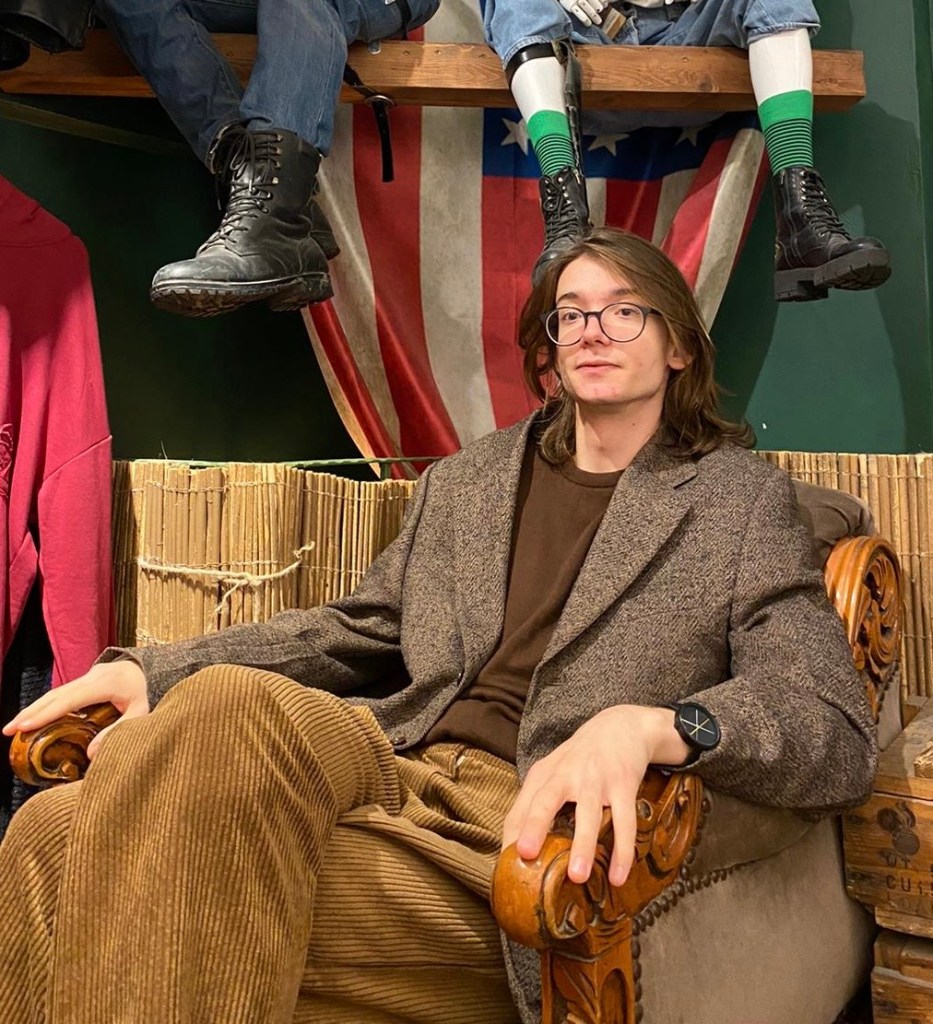
ABOUT THE AUTHOR
Berke Yazan is a social scientist and a passionate storyteller. He enjoys worldbuilding, short stories, and alternative art mediums like video game writing. He’s currently a student in the MA program ‘Artificial Intelligence’ while trying to be a moderately respected writer.
 RevUU
RevUU 