

A piece by dewi kopp
Op 3 maart 1934 werd er in Surabaya een meisje geboren dat Peggy Ann de Graaff ging heten. Toen zij geboren werd, kreeg haar broer er een zusje bij en haar ouders een tweede kind. Zij zou mijn oma worden, alleen wist ze dat nog niet.
One of my favourite pieces from my personal archive is the grootouderwerkstuk about my oma Poesje. I wrote it when I was fourteen. I’m rereading it because she recently died. Some relatives and family friends were really impressed by my dad’s eulogy, in which he recounted how she lived through three wars. My mum then told them I had written a paper on my grandmother and said that I was happy to send it to whoever wished to read more about her life.
In Indonesië had ze een heel prettige en vrije jeugd.
…
Op haar vierde jaar overleed haar vader. Hij was gestorven aan tuberculose toen hij eenendertig was. Mannen waren altijd de kostenwinners, maar nu haar vader gestorven was, moest haar moeder naar de grote stad om geld te verdienen. Peggy en haar broer Bob kwamen in de kost bij een andere weduwe met kinderen in Lawang. Haar moeder vond werk in een chique warenhuis in Malang.
My grandmother died in her Sunday best. Quite literally. She died in her car on the way to church. And no, it was not a car accident. She had a stroke when she was about to leave the parking lot in front of her post-war flat in Buitenveldert. Not only was her car still perfectly parked, but her foot hit the gas, filling the parking area with smoke and a droning sound of acceleration, immediately alerting her neighbours.
Toen ze acht was, vielen de Japanners Java binnen. De Japanners hadden voor Nederlands-Indië al de Filipijnen, Malakka, Singapore en Birma veroverd. Ze waren ook van plan Australië binnen te vallen en vaak vlogen er vliegtuigen over Nederlands-Indië. Van de regering moesten alle mensen met een tuin een schuilkelder hebben. Eigenlijk was dat niet meer dan een loopgraaf met een rietendakje erop.
I sometimes imagine her as a little girl, sitting in the trench, hearing the droning sound above her head, and imagining that it didn’t come from warplanes, but that it was the train from Surabaya to Malang. It would have taken her a lot of effort but eventually, the soil of the trench in which they were hiding almost felt like the lacquered wood of 1st Class compartments and slowly the reed roof started to resemble the iron spiles of a train wagon. Thus, the sound from the bombers would frighten her a little less.
I was working when my mother called me. My mother always calls me around six o’clock, when she is in the car home from work, so I knew something wasn’t right. I immediately sped to the VU Hospital. I bawled my eyes out while the Zuidas’ skyscrapers looked down on me. I had just stepped off the train when my parents called me again. They were in the room with my grandmother where they had given her a shot of adrenaline and had her on oxygen. On Facetime, I saw her frightened eyes behind the oxygen mask and started crying more. I don’t think she recognised my face on the screen, but I guess I can still say I was there in her last moments. They hung up, and I resumed speed walking to the hospital. I missed her death by a hair.
Als het luchtalarm afging, vluchtte iedereen de schuilkelder in. In de gang van het huis stonden rugtasjes met extra eten voor als het nodig was. Het alarm ging regelmatig af en mijn oma heeft zelfs een keer haar verjaardag in de kelder gevierd.
When we designed her funeral card, we hesitated on what birthday we should put on it. Because, weirdly enough, the wrong date was in all of her official documents. I feel like mistakes like that wouldn’t happen anymore, with the bureaucracy machines that form the government.
We picked a holiday picture as the card’s cover. My grandmother is photographed from the back, looking out over a tropical blue sea, dressed in a colourful tunic. To her left, plants flourish that only grow indoors in the Northern Hemisphere. If you look closely, you can recognise goggles and a snorkel in her right hand. Above her head, a quote from Sukarno, Indonesia’s first president, hovers in the orange twilight sky: “Hang je idealen aan de sterren, anders hangen ze niet hoog genoeg.” Most of my family thought the quote was too cheesy to fit her level-headed personality. However, she had said it to me and my cousin on various occasions. That was eventually the deciding factor.
Na de oorlog konden ze weer naar school. Om je in te schrijven moest de school natuurlijk allerlei gegevens hebben. Wat bleek, op Peggy’s geboortebewijs stond dat ze op 3 februari 1934 was geboren in plaats van 3 maart. Haar ouders hadden het verkeerd opgegeven. Op het geboortebewijs stond ook dat haar ouders haar geboorte kwamen melden op 5 maart, terwijl je een geboorte binnen twee of drie dagen moest melden. Dat kon helemaal niet. Zelfs nu twijfelt mijn oma nog weleens of ze 3 februari of 3 maart moet opschrijven als geboortedag. Maar het voordeel was wel dat mijn oma een maand eerder haar AOW kreeg.
At the funeral, we, the six grandchildren, were to carry her coffin to the front of the chapel. Just before the mass started, we positioned ourselves beside the coffin ready to greet the attendants. On the coffin lay two colourful flower arrangements. Orange lilies, pink gerberas, lilac dianthuses, yellow roses, purple bellflowers, maroon chrysanthemums and white tulips formed two carefully arranged heaps of colour, from which thick white ribbons sprung that draped themselves over the coffin lid. One flower piece from her children, and one from her grandchildren.
The dean who was to lead the mass complimented us on our colourful attire before he made his way to the front of the church. Waiting for the doors to open and the attendants to flood into the chapel, I read the ribbon from the flower piece on the coffin: “Altijd suka senang met jouw.” My eyes widened and I told my sister and my cousins to read the label. My cousin gasped, and she recounted that she was so careful to spell out the Indonesian words when she ordered the flower pieces but never expected the florist to make a spelling mistake in Dutch. We pulled a tulip out of the piece and draped it over the ‘w.’
Inleiding
Van mijn vader hoorde ik vaak verhalen over mijn opa en zijn tijd in de oorlog. Mijn opa bewaarde bijna alles en had ook een olifantengeheugen. Hij vertelde graag veel aan mijn vader en zijn andere kinderen. Maar Indo’s praten niet zoveel over hun verleden. Dat is meer uit bescheidenheid dan dat het emoties oproept. Mijn oma Peggy vertelt dus ook nooit zo veel en ik wist niet veel over haar jeugd en haar leven.
After I had sent her the finished school report, my grandmother called me. I expected her to tell me that she liked the report or possibly that some details were off. She did neither of those. She told me she now realised that she had quite an eventful life. Then she told me where I had made some spelling mistakes, and we corrected them together.
ABOUT THE AUTHOR
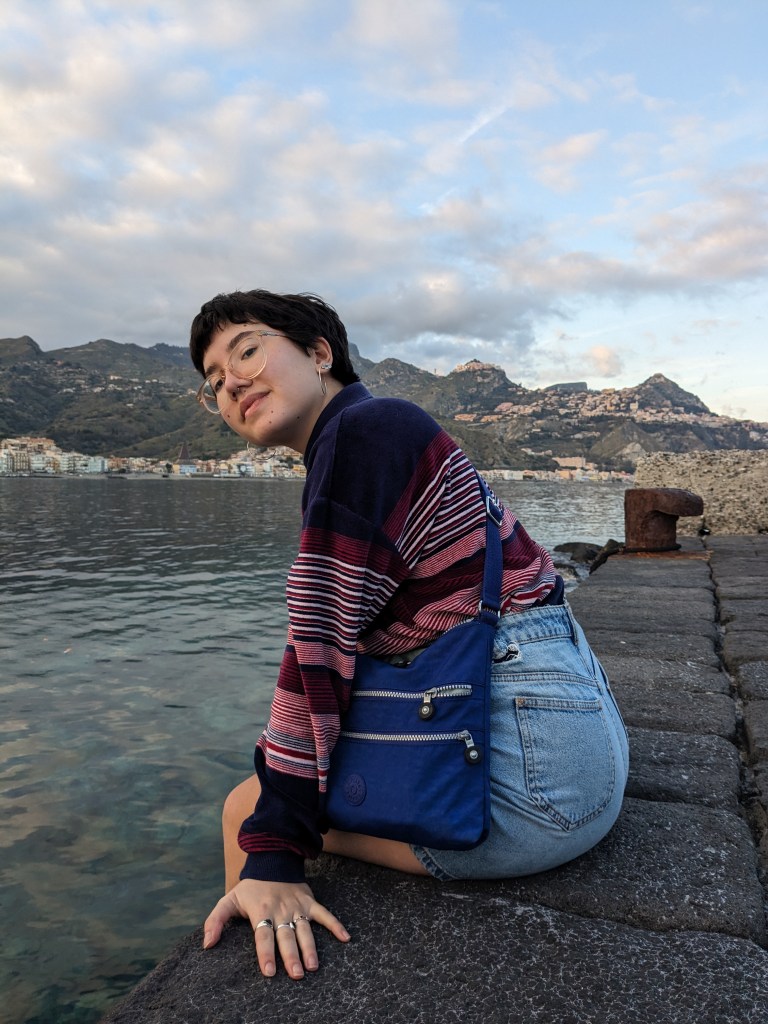
Dewi Kopp is currently a master’s student in comparative literature at the University of Utrecht. She holds a fascination for cultural memory and postcolonial studies, especially concerning Dutch imperialism. She really enjoys making things, be it knits, stories, or overpriced coffees as her side hustle.
 RevUU
RevUU 