


A critical review by kerry young
When I say monstrous woman, what comes to mind? Is it Medusa, a shape-shifting embodiment of danger and death? Or perhaps the chillingly mundane, such as a serial killer? Women have been cast as monsters in a multitude of forms throughout history and literature, challenging us to explore the countless ways in which ‘monstrosity’ can be depicted and redefined.
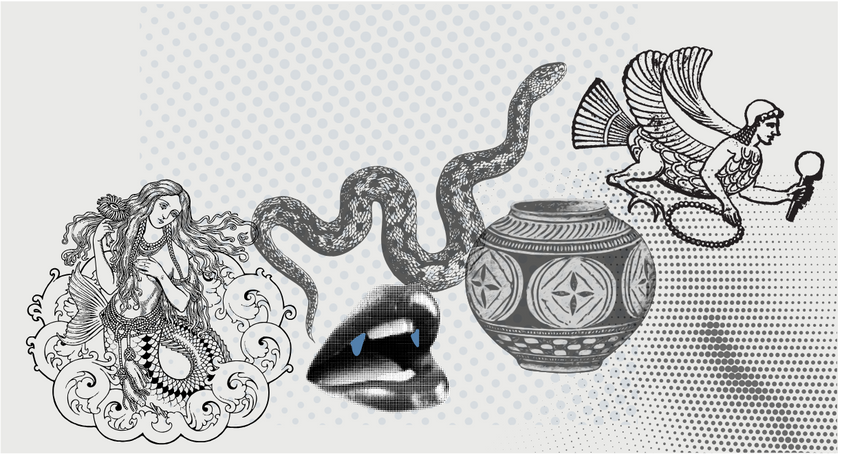
Sarah Clegg’s debut non-fiction work, Women’s Lore 4,000 Years of Sirens, Serpents, and Succubi, traces the origin of the “monstrous woman” trope. The woman as “other” has been used throughout literature and Western culture to lend credence to the dominant social structures that benefit from women conforming to a narrow set of social roles. Notably, Clegg traces the lineage of Lamashtu, an ancient Mesopotamian goddess, who shares uncanny similarities to our modern demons, Lilith, Lamia, and even mermaids. With a healthy dose of humor, Clegg explains how these ancient stories have morphed over the millennia from stories told by women for women to cope with the profound fear and horror of childbirth and infant mortality, to stories told by men for men to address concerns about sexual transgressions and morality.
Clegg, who has a PhD in the ancient history of Mesopotamia from Cambridge University, and reads Sumerian, Akkadian, Arabic, Greek, and Latin, states:
Legends of all these creatures were bound up in each other, were part of a single tradition that has spanned almost the entirety of human history. The purpose of this book is to trace this tradition, to understand how it was passed down through the centuries, how it changed, and why it was so prolific and so widespread.
Unsurprisingly, the breadth of her book is breath-taking, but coming in at just 252 pages, there is also a lot of material that is glossed over. Of course, it is impossible to go into detail about every example throughout history of the ‘Monster Outside’, a term coined by Gilbert and Gubar in their groundbreaking book The Madwoman in the Attic. This term, ‘Monster Outside’, refers to a character archetype that refuses to conform to the gendered roles traditionally assigned to them, and therefore are seen as monstrous.
It is positively monstrous that within critical discourse there exists such a huge gap in scholarly study into the ‘Monster Outside’. Adapted by generations of male storytellers as an archetypal foil to the innocent beauty, the ‘Monster Outside’ has taught generations of young women that acting with agency is monstrous. Despite the inherent richness of the original stories, there has been limited scholarship dedicated to them. I could ascribe this lack of serious investigation to many reasons: the passing on of these stories being confined primarily to oral tradition, or of being recorded in mediums such as textiles, pottery, and other stereotypically ‘female’ pursuits, which were seen as a hobby rather than a source of knowledge. Chiefly, though, it is the dismissal of women, and their stories, that has led to this defect.
The monsters that women created to help deal with the pervasive dangers of childbirth, were stripped; of their talons, their monstrosity, and remade into a different image. This new creature was one that women were told to be frightened of, despite having an outward appearance that looked like a reflection they might see in a mirror. The reason? Because these new “monsters” could be their mothers, aunts, sisters, or even themselves. But these new monsters no longer spoke about women’s fears, they had been coopted to represent a new set of fears – as Clegg writes, “These monsters were used to define womanhood in the negative, and to brand as demonic any woman who behaved in a manner deemed insufficiently feminine.”
Clegg examines the slow transformation of these monsters, from both a linguistics standpoint and from the art/artifacts that remain. Clegg articulates it as such,
Having condemned as sorcerers women who tried to protect themselves and their children against our demons, having ridiculed those who believed in them as foolish old women, a new pattern is starting here, one that we’ll see repeated again and again through the Middle Ages to the modern day: men had worked out a way to turn the legends of Lilith to their own needs, to use them to reflect their own fears – principally, their fears of women.
Horror stories have been a useful gauge of the collective human psyche throughout the years. Victorian stories such as Dracula and Frankenstein discuss the loss of humanity, as experienced by the Industrial Revolution, while our modern horror stories trend towards outer space and our fear of being colonized. Likewise, the grotesqueries that modern men have created are not, as one might assume, horribly disfigured hybrids, but rather, alluring temptresses, the “femme fatale”, or as I might cynically say, women themselves.
Clegg addresses this idea of woman as monstrous early in the text – through an unusual manner. In an unassuming footnote on page 5, the reader gets their first taste of Clegg’s dry wit, when discussing the creation of the murderous mermaids to address male fears of seductive women. She notes: “Seductive behaviour, of course, could cover anything from turning up naked and actively trying to persuade a man to have sex, to existing while a man was nearby.” Clegg’s creative use of footnotes is one of the truly distinctive and delightful stylistic choices about this book. Once considered an esoteric and pedantic tool, used only by the dustiest historians to express their intellectual superiority, the footnote has taken pride of place in this book. Through them, Clegg offers both witty insights and humorous asides. Indeed, much like David Foster Wallace’s inclusion of an entire chapter of his novel Infinite Jest within a footnote, Clegg often uses her footnotes to give the cultural information needed to understand her jokes and jibes – especially since these jokes usually reference a culture that existed thousands of years ago.
It was difficult, at times, to comprehend the motivations of these people who lived in a world so fundamentally different from my own. However, Clegg took that into account and went to great lengths to paint a picture with her words and include an image for good measure. In one short passage, Clegg explains that the purpose of incantation bowls was deeply personal:
The fear of Lilith’s seduction, for Ephra’s wife, was her fear of losing her husband’s affection (or never gaining it in the first place), and her hope that this was caused by a supernatural temptress who could be banished by a clay bowl. Her quiet desperation, preserved where she buried it 1500 years ago, is a small, heartbreaking window into a world where women were entirely dependent on their husband’s affection. To lose it was a terrifying, life-destroying prospect, and something over which they might have very little control.
She then includes an image of one of these incantation bowls for us to see the perfectly preserved wishes of women painstakingly painted onto a small clay bowl. It was surprisingly poignant to see the hopes and dreams of a woman carried forward through time, making Clegg’s concluding comment in the footnotes: “In a crowded field, this man’s bowl is an absolute embarrassment…”, particularly satirical, while also helping me to understand the stakes.
In Jonathan Russell Clark’s essay On the Fine Art of Footnotes, he mentions that authors like Wallace, Klosterman and Nabokov all used footnotes as “a chance for meta-commentary. They can – with doleful hindsight like Klosterman’s or circuitous neurosis like Wallace’s – both compose a piece and comment on it, but because they aren’t commenting within the narrative itself, and because the technique they use comes from authoritative academics, the footnotes grant these tangential asides a kind of authority not offered by, say, a parenthetical.”
However, Clegg’s footnotes are not just humorous additions to the text, but also important to the overall tone and structure of the book. Take, for example, her footnote on page 76, that starts halfway down the page and continues to take up the remainder of the bottom half of the next page as well. Instead of the pedantic, dry tone that most non-fiction scholars seem to feel is their honor-bound duty upon receiving their degree, Clegg uses a conspiratorial, inclusive tone, inviting the reader to join in on her mirth or scorn. Perhaps my favorite footnote occurs on page 142, referencing a Medieval cardinal Peter Damian, whom she finds particularly repulsive – “He’s credited with inventing the siesta, and it’s telling that even this cannot outweigh his negative qualities” Clegg jokes. Which I think speaks to Clark’s point that “Footnotes, in other words, no longer merely support a story; now, they can be the story.”
Overall, I found this book a thought-provoking journey through the western world’s conception of femininity and what it means to be “monstrous”. I relish the opportunity to share a conspiratorial wink with Melusine the next time I see a Starbucks, or bite back a chuckle as I see more of these monstrous women invading our culture and reclaiming their place in our collective imagination.

ABOUT THE AUTHOR
Kerry Young’s natural habitat is a world of words, where she delves into the realms of monsters and mythology through her writing and voracious reading. Her deep passion for folklore is rivaled only by her aversion to the truly eerie. Armed with a BA in ‘English Literature’ from Florida State University, Kerry is currently pursuing an MA at Utrecht University. Prior to wielding her proverbial pen as a critic, she dedicated herself to the art of education, helping students refine their writing skills.
 RevUU
RevUU 