


A critical review by genta tanjung
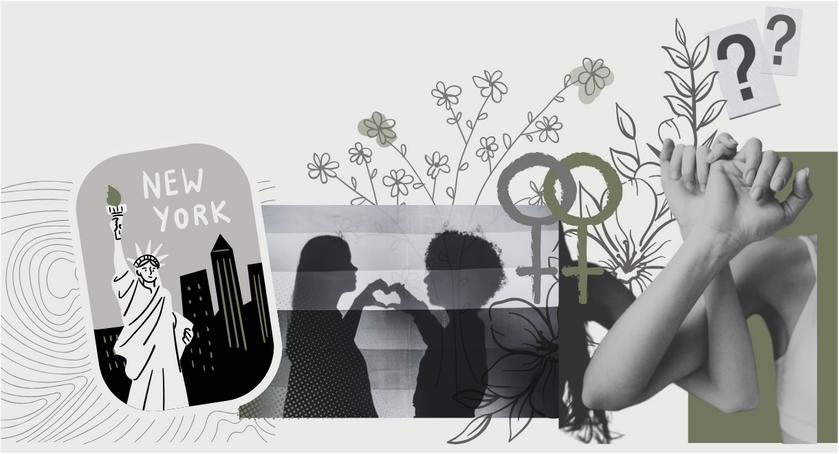
I was fifteen years old when I realized I liked girls, something that a decade later I still know to be true. So no, it was not a phase, Dad. I recall the moment the realization became real for me, and it was mostly scary. Being queer was a concept that at the time was foreign to me. I thought, sure, that’s other people, but not me. Had I known that it was only the beginning of my journey in finding my identity, things might have been better or easier.
Still, looking back, I would not change a thing. I needed to go through years of many sleepless nights questioning myself, my attraction. Even when I thought I was finally at peace with this, there came a new question: But who am I really? Which label would I use? What category am I in the community? I spent a large portion of my young adult life identifying myself as anything other than ‘lesbian’. I would say I’m queer, I’m gay, at one point I thought I was bisexual. There is nothing wrong with any of those labels, but I have never really felt like I could relate to them. This is a common theme amongst queer women growing up – a refusal of the existence of themselves and their identity under the pretence of normality.
It wasn’t until I read the 1980 essay by Adrienne Rich titled “Compulsory Heterosexuality and Lesbian Existence” that I found the right words that could help me to navigate the ups and downs of what it means to be a lesbian.
Even before I wholly knew I was a lesbian, it was the lesbian in me who pursued that elusive configuration. And I believe it is the lesbian in every woman who is compelled by female energy, who gravitates toward strong women, who seeks literature that will express that energy and strength.
What Rich wrote here really speaks to me, it made me no longer have desire to be invisible, and I want to make space for myself in society.
Naturally when I found out about Dykette by Jenny Fran Davis, a novel that features lesbian leads, I wanted to read it immediately. Dykette is so unapologetically queer. Davis manages to capture the complexity of queerness through the characters that represent every sexual identity under the sun. It was a journey to go through this novel, I can’t imagine giving this book to a heterosexual person and trying to make them understand it. Notably, other women-loving-women books tend to shy away from explicitly calling a character ‘lesbian’, but Davis is not afraid of this at all. Davis is successful in her blunt portrayal of queerness in all its glory: the good, the bad, and the ugly. But I think the complexity of queer identity goes beyond what Davis is trying to achieve with this book.
Sasha and Jesse are a twenty-somethings dysfunctional couple trying to make a living in fast-paced New York. Sasha thrives with everything ‘normal:’ she wants to settle, she wants to get married, she wants children, she wants that white picket fence life, and she wants to be the ultimate femme wife to her butch boyfriend (Sasha refers to Jesse as both her boyfriend and girlfriend). Jesse, on the other hand, just wants to be young, fun and enjoy everything they have now. When their older, wealthier, more settled friends Jules (a local celebrity host) and her girlfriend Miranda (a therapist) invite them on a ten-day getaway, they jump at the opportunity. The trip only gets more exciting as they are joined by a third couple, Jesse’s best friend Lou and their Instagram-famous girlfriend Darcy. What can go wrong when three pairs of lesbians spend their vacation together under one roof for almost two weeks?
Things take a turn as they grow more intimate within one another, with secrets and confessions being thrown out left and right. All the characters get entangled with each other, within and outside of the relationship that they brought to the trip. Sasha has a crush on Jules but tries to hide it out of respect for Miranda, even though she thinks Jules might feel the same way. Sasha despises Darcy long before the trip. She has suspicions that there’s something going on between her girlfriend and Darcy based on Jesse’s fascination with her nemesis. Sasha looks down on how attention-seeking and clout-chasing Darcy is, but secretly envies her it-girl persona. Jules and Miranda are practically married and are even discussing having children, but Miranda says she does not want to be an old mother, already being in her late 30s. When Jesse and Darcy collaborate on an artsy but sensual livestream performance, Sasha can no longer contain her jealousy that eventually sends her into a spiral of rage. Long story short, things get very chaotic.
The novel is sectioned into three parts, titled “Minx,” “Princess,” and “Bimbo.” The overall story centers around Sasha, and the section titles reflect the various types that Sasha aspires to be. Although most of the novel takes place between the end of December and early January, a few scenes are a set in the past, to show how the characters started their relationship, before they become who they are now.
Here comes the part when things get even more complicated; Each character represents a lesbian identity outside of the usual norm of a pretty girl who likes girls. Jules and Miranda are the traditional older lesbian couple, Sasha is a full-blown femme, Jessie is a dyke who uses she/her and he/him pronouns interchangeably, Lou is a masculine non-binary person who undewent top surgery, and Darcy is another femme.
Everyone here is clearly performing gender, performing their identities, and are very committed to the bit. In fact, they seem so committed that it almost becomes heteronormative. Sasha is a clear portrayal of this, she is very much obsessed with being a baby angel face femme bimbo to the point that she solely bases her identity around her butch girlfriend. It is like her whole being only exists because she is validated by her masculine butch counterpart.
Even though I find myself relating to some layers of Sasha, as we are both femme lesbians, I still find it unsettling how she views herself. Her ultimate goal is to be a homemaker, she thinks that her purpose would be complete when she finally becomes The Wife. There is a part in the story where Sasha has a conversation with her ex about gender roles, they argue about the roles that they’re supposed to take as the man and the woman in the relationship even though it’s a lesbian relationship. Thus, she makes it clear what kind of roles that she actually wants out of the relationship:
Sasha did not want strict gender roles so that she would have to climb out of bed and fetch a bowl from the kitchen. She wanted strict gender roles so that the ex would protect her, provide for her, and wear men’s clothing.
Being domesticated and wanting to be a housewife are almost always what Sasha talks about, as if her whole personality is trying to prove her femmeness and to confirm her femininity in every way possible. I can only imagine how demanding it is to have to be constantly performing this identity and expecting to be praised all the time for simply just showing femininity. Davis explains that this antic is called ‘dykette’: “seen-by-butch” “seen-as-femme” and “containing both the butch’s gaze and the femme’s stare”. This term explains a lot about the binary roles in the novel, on how there are only distinct identities between the feminine side and the masculine side.
I am very aware that just because a book is inherently queer, it does not need to be ground-breaking or constantly offering something new. It can be nice just to read a clichéd romance between two women. But sometimes this story feels like an empty vessel: full of nuances and theatrics but failing to deliver what it is supposed to give. I do not think I can quite tell whether Davis is actually hitting the right mark with this portrayal, as she describes in her interview with Vanity Fair:
There’s the question of, is the book serious? Are the characters serious? Does Sasha really think “faking it” is easy and fun? Is she just trying to be funny? Then there’s the bigger question of: Is it a serious work of literature? Is it a serious work of fiction? What I hope is that the book is taken seriously, or semi seriously, in its celebration of joy and humor and gossip.
I think I can see what Davis is trying to do by creating these characters and underscoring the identities they represent; her depiction of queer life is candid and raw, which is not something that we read every day, since there is not that much space for queer, especially lesbian, fiction. But still: now I am trying to find out if it does more harm than good. I find it stereotypical that the portrayal of the characters centers around the question of what femininity and what masculinity is. Isn’t the point of being in a lesbian relationship the capacity to exist outside an assumed and dictated agenda?

ABOUT THE AUTHOR
Genta Tanjung is a graduate student at Utrecht University studying ‘English & Comparative Literature’ for which she was granted a fully funded scholarship from the Indonesian Government. She worked as an English teacher after finishing her BA in ‘English Literature’. Her specialization is contemporary queer fiction. Outside her academic ventures, she enjoys analyzing horror media adaptations.
 RevUU
RevUU 